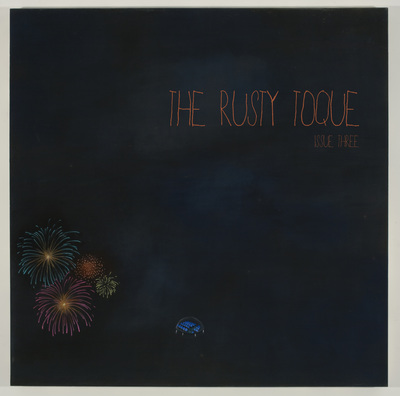
ISSUE 3
CONTENTS
CONTENTS
PORTFOLIOS
VIDEOS
CHANGING A LIGHTBULB (WITH SUPPORT)
FICTION
|
EVERYONE LIKES A LITTLE GUY
by Rebecca Rosenblum He had soft orange hair, and he was big. Not fat; just good strong bones. He’d clearly been tramping through the muck, and all over he was burrs and bits of grass. He had a collar on—bright purple—so he was someone’s lost friend... Read More |
What I didn’t say: I was awakened later that night by your face, tender and humiliated in those moments after I hit you. When I pushed back the currents to see who was shouting in the front yard... Read More
|
BARE-CHESTED MEN IN PUBLIC MAKE ME UNCOMFORTABLE
by Roxane Gay My husband cannot stand being hot. He cannot stand being uncomfortable in any way. He is an only child. Every night as we’re lying in bed, he says, “Feel my forehead,” so I press the back of my hand against his cool... Read More
|
GOING TO A PARTY IN YOUR MID-TWENTIES
by Suzanne Sutherland First, you walk into the kitchen. No, first you walk through the front door. No, first your friend opens the front door for you. Your friend who lives in the house where the party is happening. Your friend who is hosting... Read More
|
POETRY
|
LINE DRAWING
by Jessica Rohan When Bryn lived with her parents, they would tell her things, like “America is the good guys,” and “If you... Read More |
LIGHTNING STORM...
by Souvankham Thammavongsa Where once there swirled cottons of soft white and various hues of blue Some bent metal wire charged...
Read More |
ONE IS FREQUENTLY MISUNDERSTOOD
by Jacob Wren Evil is just bad choices vehemently pursued like a course in doing the right thing where they teach you...
Read More |
JELLY BABY
by Robyn Read The mule that sat in our living room was good at hoovering. When he got to his loose-lipped action you... Read More |
|
THE TRUTH ABOUT LOVE
by David Groulx It’s cold and raining outside I want to curl beside you like a cat dying of tetanus from an infected wound you gave...
Read More |
nothing is true everything is permitted permitted is true nothing is everything nothing is permitted everything is...
Read More |
SCUBA VS AQUA LUNG
by Geoffrey Nilson to swim without surfacing air pops out in long trails that roll up in cobalt motion, adamantly plumb with... Read More |
TOURNIQUET
by Catherine Graham Nobody can say she can’t beat him on the tennis court. Her shots land safely on lines and chalk flies up in puffs... Read More |
|
Doctor says to his student, she is sexually active, monogamous, not pregnant.
They curve around my bed... Read More |
DRIED MY EYES
by Peter Norman Dried my eyes and slunk out of the tower where I worked and found the smokers clustered by the door... Read More |
VISION OF DEATH'S VIRTUES
by Gerard Beirne |
i dont think its fair uv peopul trying 2 stop fish from farming dew yu why ar peopul sew mad at say... Read More |
MONOLOGUES
|
CARDIGAN CONFIDENTIAL
by Hope Thompson MISS SHACKLETON (suddenly attentive) I met Ellen several weeks ago. When she began her employment with me. October third, to be precise. I hired her myself, although Miss Ross did attend the interview. Hiring for positions in the adult section falls under my purview, being section head. Why Joan--I should say, Miss Ross--finds it necessary to attend adult section interviews is a question only she can answer. I would hardly waste my time attending her children's section interviews. I can think of nothing more tiresome.
Read More |
BOY IN HOODIE
by Daniel MacIvor BOY IN HOODIE: “Life Is Death”. As a band. Excellent band name. It’s everything. It’s true. It’s tiny. Protons and neutrons and subatomic particles. A Universe the size of a particle of a particle of a particle of a particle of a grain of sand on a beach of particles of particles of particles of grains of sand Universes. Times infinity. And constantly in motion. Without movement there is nothing. But that’s not death. Death is different than nothing. Those protons and neutrons and subatomic particles don’t die. They just are or are not. Only ideas die.
Read More |
RUSTY TALK
|
Kathryn Mockler: What is your first memory of writing creatively?
Semi Chellas: I wanted to be a writer as soon as I knew what that was. My mom was a freelance journalist and she had set up a little desk for me next to her desk. I must have been five or younger, and I had her taking dictation for this book I was working on that involved a lot of puns. When I was 7, I wrote a novel in twenty 3 by 5 spiral notebooks—it was the story of a girl with a tail who lived in a country where people with tails were enslaved. And basically she was trying to get Han Solo to smuggle her out of there. I submitted a story to The New Yorker when I was 16 and got a hand-written rejection. Later I think it became a liability for me. I had to get rid of the romantic ideas I had about being a writer and actually learn to write. Read More |
Kathryn Mockler: What is your first memory of writing creatively?
Lynne Tillman: When I was eight, I wrote a composition about Charlemagne. My class was asked to write just one. But I got carried away, and wrote two. That thrill, rush, gave me a sense of power, freedom, pleasure—an eight year old's version. KM: Could you describe your writing process? LT: I'm erratic. I don't have an everyday practice, except when I want to do it, want to write it, whatever it is. Then I become compulsive, and sit at my desk, at the computer, for hours without moving. Except for getting a cup of tea. But I can forget to eat, and begin to feel heady, dizzy. Read More |
REVIEWS
|
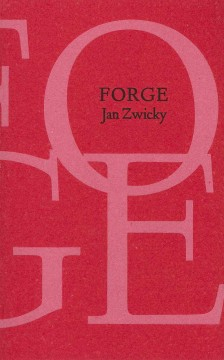
Introducing a work with a short quotation is not an uncommon practice, and one that I like, actually, because it offers a little lens through which the work is enhanced. This is what the untitled sonnet, appearing as the first poem, does in Forge.
Take me to the place where I can climb no further. Leave me barefoot in the snow and mapless: I will come to you. Marry someone else, raise children: I will sleep each night, my shoulder to the weather-stripping of your basement door. Join the Foreign Legion, sell the farm, Read More |
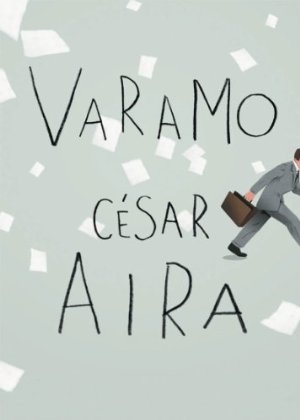
In less than a day, the eponymous protagonist of César Aira’s Varamo, wrote The Song of the Virgin Child, a poem that the novel describes as the “origin and apogee of the most daring and experimental avant-garde movement in the language.” That we are told Varamo had never “written or felt any inclination to write a single line of poetry, nor would he ever again,” seems to announce definitively that Varamo is a work of magical realism.
Read More |
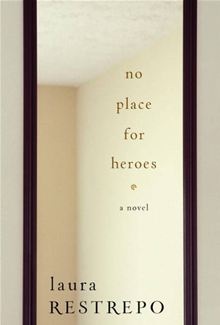
Laura Restrepo is a prominent Colombian novelist who counts José Saramago among her admirers, and who won the Premio Alfaguara de Novela in 2004 for her novel Delirium, which has enjoyed a strong international reputation. Given this background, it is surprising that her 2009 novel No Place for Heroes (translated into English in 2010 by Ernesto Mestre-Reed) falters.
The conceit should work. Read More |