
I reviewed Gwen Benaway’s poetry collection Passage, which was published recently in Arc Poetry Magazine’s Canada 150 Reconciliation issue. The review started with a reference to Neal McLeod’s book, Indigenous Poetics in Canada. After the publication of the issue, I posted a photo of the review on Twitter. The photo led to a Twitter conversation with Gwen where she informed me of the problem that lay in invoking McLeod in a review of her work, given his history of domestic abuse of Indigenous women. The news of his abuse had broken publicly a few days before I posted the photo on Twitter, while it had been common knowledge within the Indigenous community. While I acknowledged the news as something recent and something that I had been unaware of, I also began to defend the review itself. Instead of being a productive conversation, the conversation became a disagreement. Doyali Islam, the reviews editor for that particular issue, stepped into the conversation, but the conversation ended without any resolution . The next day, after I had a chance to reflect on the Twitter interaction and the actual issues raised by Benaway, I reached out to her via email with an apology. Over email, we were able to unpack the problems raised by the presence of McLeod’s name in the review. The following interview rose out of that initial email conversation. Benaway and I met in downtown St. Catharines during Queer Canada, and over lunch, unpacked some vital issues plaguing CanLit in relation to Indigeneity, today. – Sanchari Sur Sanchari Sur: I was going to start with our online interaction and your reaction to the review. I want to contextualize the interview within that conversation and move forward from there. You can start by addressing how my use of McLeod’s name, as well as my ignorance about McLeod, was problematic, and why that affected you. Gwen Benaway: I reacted to the presence of Neal McLeod’s name in a review of my work because my work is situated in femininity, and situated in a response to forms of violence against female bodies, that having the name and intellectual and literary work of an abuser referenced in the context of my work felt like a kind of violence again against my work. My personal links to both Neal and the women that he impacted, which extends on multiple levels for me, was something that forced me I guess, in the context of seeing his work in the review, to have to reengage those kinds of narratives and memories that I have. It felt like a kind of a specific violence that emerged from a lack of knowledge around Indigenous peoples and community. [Within Indigenous community,] Neal’s relationship to women had been known for a very long time and was openly talked and spoken about, and the challenges and issues around his work as well as his own relationship were well known. Most of us had started to avoid and dissociate ourselves and our work from Neal’s work as a response to that. I think a member of the Indigenous community would have had that knowledge, would have come in with that awareness, and that understanding. It’s not a critique of you or your own positionality within that, but it’s epidemic of the ways that Indigenous work is often taken up by non-Indigenous audiences in ways that don’t understand the context that the work is emerging out of, and can’t truly appreciate or understand the intersections that are happening. And often without meaning to, render that work or interpret that work only in relation to [themselves], and can’t actually hold the work in its wholeness, and that is kind of a frustration. For me, having [one’s] poetry collection reviewed in Arc, as Canada’s premier poetry magazine has a kind of prestige in association to it, and is something that I wanted having been a reader of Arc for a long time, and when it happened, it happened in this context where – the review itself was fine – but [has] this predatory male presence sitting at the front, overshadowing everything. But also, my own need to then have to engage, and say, ‘But I don’t support Neal, but I stand with survivors, but my work is not reflective of Neal or his politics around Indigenous poetry but in fact in opposition to [it]’. SS: [Arc had] an Indigenous guest editor for that specific issue [and] I wonder if it had been somebody who was not a male Indigenous editor, would [they] have caught this? GB: I think that would have produced a change. I think older male Indigenous writers, particularly older male celebrated Indigenous writers, are often implicated in some of the kinds of gendered violence which have happened in our communities, and within the Indigenous literary community. But I think that there is also a certain sensitivity to Indigenous female writers and work, which we have developed with each other and through each other as Indigenous women writing, that doesn’t translate into Indigenous masculinity. And, an Indigenous woman of my generation connected to me in peership, I think it would have been different. Ultimately, the role of an editor is a complex one. It falls a lot on who is doing the review, who is editing that review, and who is placing that review. So, there’s layers of accountability within that, and also layers of community access and knowledge. So, I don’t know if having an overall issue editor who was female Indigenous would have produced systemic change. SS: Do you think that non-Indigenous writers should not at all attempt to review or – I mean, it would be problematic to say “engage” because if you are not engaging with the work, then what is the point. We should be engaging with the work to some extent. GB: I mean, I think it’s important for non-Indigenous folks to engage with [our] work. I also think it’s fine for non-Indigenous folks to review [our] work. But I know in my own writing practice, when I do reviews of works that emerge from communities that I don’t know and am not a part of, I reach out to members of that community, either to the individuals themselves or people who exist within my social network, who can let me know if I have missed something or if I am presenting that community in a way that’s wrong, or if I am missing the point, or if I am interpreting something from that text that I am seeing through my particular lens which doesn’t reflect how it would show up within the community. I think the work of being a good ethical reader and writer is addressing and seeing your own positionality, and trying as much as you can to reflect the positions of the community that you are speaking about. It may not always be perfect; in fact, it can’t be perfect. But I think it’s good that you show efforts of good faith and try to negotiate that process a little bit. SS: What I am hearing from you is this idea of listening, and to listen better, and to listen responsibly. Is there any other way that the non-Indigenous community could listen to Indigenous writers? GB: I think it’s good to engage Indigenous works, to listen to Indigenous people on social media and other platforms, to engage in those conversations. And, I think it is good to develop personal relationships. I think decolonization and the process of reconciliation occurs in the intimate relational space between people. As much as possible, I encourage non-Indigenous people to try and enter reciprocal relationships with Indigenous writers and Indigenous people that allow them to have some of those nuanced conversations. But I also wonder, when the news of Neal broke, when it became public knowledge, before the [Arc] print publication – a helpful strategy would have been to reach out to me and say, ‘Hey, I referenced Neal in this work and now I am aware of this other stuff, I am sorry about that.’ That simple relational gesture, I think, is reconciliatory. That kind of reparative work within a writing community, I think, goes a long way to build those kinds of relationship networks. SS: You are right. I should have done that instead of being defensive about it, and trying to defend so hard on Twitter, which is why I reached out to you. I am glad we are having this conversation. Obviously, I don’t want to repeat something like that in the future, and nor would I want somebody else in my position, perhaps another person of colour, who is not aware of the nuances, who has a difficult subject position themselves, [to repeat the same mistakes]. But I think by shutting down the Indigenous community, instead of engaging – therein lies a problem, therein lies the replication of exactly the kinds of systems we are trying to fight. We don’t want to be on opposite sides. We want to be on the same side. GB: And I think that’s a conversation to have around communities of colour and Indigenous people. I think it’s very hard for communities of colour to hear critiques around Indigeneity. I see a lot of defensiveness and anger and fragility, to be honest, emerge in those conversations. And, I think it’s useful for communities of colour to understand that spurring up with Indigenous communities doesn’t mean you are racist. It doesn’t discount your own experiences of racial oppression, and the knowledge you bring from your community and your specific colonial oppressions. But it’s important to not conflate that critique from Indigenous people with yourself. And I think that there is a tremendous amount of fragility built into being a racialized body in the world. We are constantly under attack, we are constantly proving ourselves. So, I think that when you get a critique from an Indigenous person, it is easy to be really wounded by that. But I think you have to fight through that woundedness to be able to say, ‘Wait, did I get this wrong? Maybe I did get this wrong. And, how do we work through this?’ SS: I think a part of the problem lies in the kind of privilege that is held by those who are not – say, for me, as a non-Indigenous person, I have a certain amount of privilege. I am also in academia, which adds more privilege to my position – so, there is a comfort in that privilege, a comfort in having that position of privilege, and not engaging with those who are in more oppressed positions. I think a lot of people don’t want to give up that privilege. In communities of colour – like you said, we are already under attack – we are trying so hard to protect what we have, that we forget that we might be harming other communities, unknowingly. GB: Yeah, and I think Indigeneity is one of those really complicated and nuanced things that functions often like race. But it’s different from race in a way that it presents itself in Canadian society, and that tension is a very complicated one. I think, there isn’t a lot of conversation visible between communities of colour and Indigenous communities, about ‘how do we participate in each other’s oppressions? How do we alter that? How do we build alliances that are meaningful?’ And, Indigenous people are often reduced to figurative representations. I have used this line before, we are the ghosts of Canada, and we often get reanimated by communities of colour and held up as performative land acknowledgements, but not have any actual relationship to Indigenous people in their life. I think there is a very complex and nuanced conversation that really needs to happen around ‘what is the relationship of communities of colour to Indigenous people in Canada, now and historically? And, how do we narrate those histories and realities, and build something from that?,’ where we are not just reacting to whiteness, but we are reacting to each other. SS: And, that kind of segues into a conversation about social media, as it was social media that started this conversation in the first place. At IFOA, you mentioned that social media is a space where Indigenous people come together, exchange ideas, and create community. How do you think social media has been instrumental in your own visibility? GB: Social media is really valuable for Indigenous people, and Native Twitter has proved itself to be a very powerful force, both for the critique and accountability in Canadian politics. What I see is Indigenous people who are coming from different nations, and landscapes, and geopolitical positions, intersecting through Twitter, and having a national dialogue around Indigeneity. And through that space [of social media], we find a lot of empowerment. And that’s why we default to it. And that’s why it’s a space where we are able to create in one of the few ways that almost never happens in Canada. Like, literally, a multi-nation Indigenous space where we are all there, speaking, interacting, and talking. And through Twitter, because of its ability to ‘mute,’ it can actually be a space where it’s just us. We support each other, we jump into conversations, we retweet each other. We are able to engage in community building in community solidarity, which we don’t get to do anywhere else. It is a really valuable space for me, and I think it’s our default way of communicating. I kept getting feedback from you and the Arc [reviews] editor [for that issue] that Twitter is not the best place to have conversations. I found that really interesting because for us, as Native people, Twitter is the best place to have conversations. And for me, as a trans woman, it’s a protected space, because I have control and access and agency around what I say and what is said to me, whereas, I don’t have that in interpersonal interactions. In some ways, I want to problematize that idea that social media is somehow reductionist and limiting in conversations. I think [social media] actually opens up a lot of space and safety which Indigenous people, or trans people, don’t actually have in everyday life. SS: That’s interesting, because for somebody like me, I am the kind of person who is not very good at having conversations on the go. I mean, person-to-person, it’s different because there are other cues happening, but something like Twitter is like texting. It’s hard for me to convey tone, for example, or to convey where I stand. Sometimes, I assume the other person will understand what I am saying, but some things get lost in translation. And that’s why I said, let’s have a longer conversation, which email allowed me. I could sit down, get my thoughts together. But I understand what you are saying. [Social media] doesn’t have to work like the same kind of space for everybody. GB: And it also builds in accountability. If you say something [racist or transphobic] on Twitter, there is a built in accountability around it. So, it creates a protection. For me, violence which is brought to bear on me or my body as a trans or an Indigenous subject, there is a record, and a way to speak back to it. For other forms of communication, I worry if that record exists, if there is a way to actually feel safe in having those conversations around Indigeneity. SS: I agree, but I have also heard this critique from other people, that Twitter is a space, or social media in general is a space, where people in CanLit who are very vocal are performing by being reactive. Do you want to speak to that kind of a critique? GB: I think that critique misses the point. Because we are social beings, we exist in social spaces. So, every act is performative, whether that’s in conversation, or via email, or in relational spaces. Sure, you can make the critique that there is a kind of activist and social performativity happening in CanLit spaces. I feel that is absolutely true, and probably doesn’t reflect a genuine engagement with important issues. But I would question that and say that you can actually ascertain if those vocal people being critiqued are actually “performing” that kind of performance. They might actually be honestly engaging – like in my case – with issues in a venue and format that’s safe for them. Sure, everyone is performing and you can say some performances are problematic cause of the way they are situated or who their intended audience is, but I think you can make that critique in any space. SS: At your Queer Canada keynote yesterday, you talked about the precarious position of being both Indigenous and queer. Have you ever considered the “precarious position” perhaps as a space of resistance? [Here, I specifically refer to Sara Ahmed and her mobilizing space of unhappiness as a space of empowerment for feminist killjoys]. Is it possible for this unhappy precarious place to be something else? GB: I understand [Sara Ahmed’s position] but I return to the notion of Indigenous wholeness, where I don’t want our happiness to be complicated. [Laughs]. I want our happiness to be straightforward. What does Native joy look like? What does Indigenous joy look like? And, can we return to that? And, can we return to the conversation about how we hold each other, and stand within ourselves as Indigenous people without having to negotiate or mediate ourselves through the history of violence against our bodies? How do we reconnect and reanimate ourselves without having to rely on outside forces? That kind of emotional, spiritual sovereignty is what, I think, our ancestors envisioned, and what I understand of Anishinaabe world view, and what our inheritance is. And, I want to see a return to that, to not a complicated happiness, but to an uncomplicated joy. It may not be possible but I think we must strive towards [it]. And that means to me, rejecting things like queerness, which to me, as you have articulated, will always be a complicated happiness. SS: At the Bechdel Tested Panel at IFOA, you mentioned that as an Indigenous person, you don’t see yourself as a part of Canada. But at the same time, your works exists within what is known as CanLit or Canadian literature. So, in that sense, do you think your own positionality is different from the way your work is being positioned within the conversation of Canadian identity? GB: I would posit that Canadian literature, or CanLit, is more than a practical reality. I would argue that it’s an ideological space, and an idealist space as well. So, I think while my work [is] practically considered part of CanLit work – it’s published by a Canadian publisher, it’s sold in Canadian stores, I attend Canadian events and speak to Canadian audiences – I think my work doesn’t ideologically enter the space I consider CanLit. And I think that ideological space of CanLit which I think my work falls outside of – and other Indigenous writers, and I would argue some racialized writers as well – is the ideological space of creating Canadianness, of multiculturalism, and diversity, and Canadian markers, and nationalism embedded within our work. I think we fall out of that ideological project. I think we fall out of social spaces as well. Indigenous and racialized writers are often used by CanLit as tokens, as representative members of our communities, to prove a kind of diversity, or as entertainment, to show up as exciting and different stories of worlds and cultures that they don’t understand. But that is not true inclusion. We are not actually part of CanLit. I would problematize the framing around the ideology of CanLit, and the practicality of CanLit, but not part of it as an ideological construct. So, I don’t see my work as being Canadian. I do see my work as being Anishinaabe. I do see my work as being Metis. And, I do see my work as being transsexual. But I do not see my work as being Canadian. SS: You know, how Nick Mount’s Arrival, a book about early Canadian writers, was published recently, and there are no Indigenous writers at all included in that book. It is ironic because Indigenous writers have always been excluded from the framing and making of CanLit, so then, why should Indigenous writers even want to be a part of the canon of CanLit. And, that exclusion is still happening now, as the writer of that book is also a professor at a prestigious Canadian university. All of this goes back to Neal McLeod being published by a university press, and his book being on comprehensive exam lists for doctoral students. All of this highlights the underlying problem that lies in the construction of CanLit; that is, which books get published and circulated. I am glad for the suggestions you have made in place of McLeod’s book [in your email to me], like Katherena Vermette’s North End Love Songs (2012),Gregory Younging’s Elements of Indigenous Style (2017), and Daniel Heath Justice’s forthcoming book from Wilfrid Laurier University Press, Why Indigenous Literatures Matter (2018). A final question would be about your forthcoming work with BookThug. What kind of work is it? GB: Holy Wild is a collection of poetry that really tracks the first year of my transition. And there [are] two kinds of threads in it. There is a thread where I am talking about the physical, emotional, and social experience of transitioning, and drawing connections between being trans and being Indigenous, the relationships I see between Indigenous worldviews and trans embodiments, and how those are linked and connected for me, and really documenting the social and emotional landscape of going through that change, and its implications on me. [The collection also] traces two relationships with white cis men. So, half of the collection is sort of a doomed love story, and through that conversation, it begins to explore trans intimacy, the relationship between Indigeneity, whiteness, and white masculinity, and how those intersections impact you as a person as you go through that. SS: So, it’s more like the essay in The New Quarterly, “Trans Girl in Love,” and the stuff about vulnerability that you wrote about? GB: Yeah, it’s more of that for sure. GWEN BENAWAY |

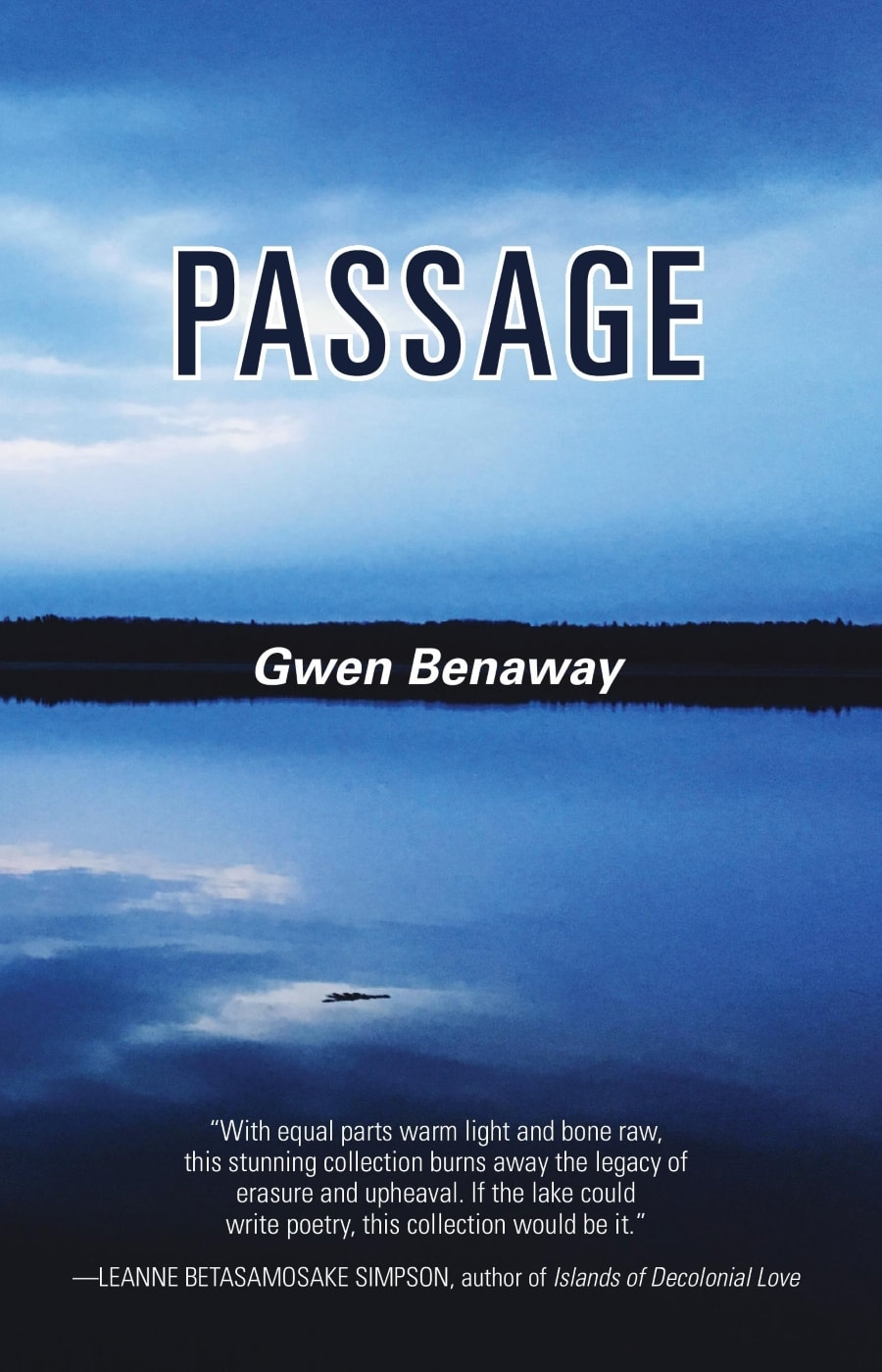 | Description from the publisher: In her second collection of poetry, Passage, Gwen Benaway examines what it means to experience violence and speaks to the burden of survival. Traveling to Northern Ontario and across the Great Lakes, Passage is a poetic voyage through divorce, family violence, legacy of colonization, and the affirmation of a new sexuality and gender. Previously published as a man, Passage is the poet’s first collection written as a transwoman. Striking and raw in sparse lines, the collection showcases a vital Two Spirited identity that transects borders of race, gender, and experience. In Passage, the poet seeks to reconcile herself to the land, the history of her ancestors, and her separation from her partner and family by invoking the beauty and power of her ancestral waterways. Building on the legacy of other ground-breaking Indigenous poets like Gregory Scofield and Queer poets like Tim Dlugos, Benaway’s work is deeply personal and devastating in sharp, clear lines. Passage is a book burning with a beautiful intensity and reveals Benaway as one of the most powerful emerging poets writing in Indigenous poetics today. |
 | Jordan Abel is a Nisga’a writer currently completing his PhD at Simon Fraser University, where he focuses on digital humanities and indigenous poetics. Abel’s conceptual writing engages with the representation of indigenous peoples in anthropology and popular culture. Abel’s first book, The Place of Scraps was a finalist for the Gerald Lampert Memorial Award and won the Dorothy Livesay Poetry Prize. Abel’s second book, Un/inhabited was published in 2014. CBC Books named Abel one of 12 Young Writers to Watch (2015). His third book Injun won the 2017 Griffin Poetry Prize. |
I am very interested in how poetry can be mobilized as a form of critique. I think you could read my poetry as being a poetics of critique but also as a poetics of decolonization.
Jordan Abel: When I think about where poetry fits in, I’d have to say I am very interested in how poetry can be mobilized as a form of critique. I think you could read my poetry as being a poetics of critique but also as a poetics of decolonization.
SB: What about poetry do you find valuable in helping to destabilize the architecture of colonialism?
JA: It’s tough to put a finger on. It’s a number of things. One: it’s the licence to be able to use found text and manipulate it into a form of critique or reorganize it so the underlining colonial logic in those texts is revealed, but it is also about the lack of boundaries that surround poetry. Poetry is a very open, artistic genre. There are very few constraints put on poetry. Poetry can be anything and I find that really interesting about the genre. It is so fluid and flexible that it allows for a whole range of creative intervention.
SB: Absolutely. Something I really appreciate in your work is the way you communicate the complexities of indigeneity using form and space on the page. Poetry as a genre can provide an alternative space to unpack the layers, the multiplicity of voices, and a variety of contexts surrounding indigeneity.
JA: One of the things that comes to mind when you are talking about layers and genres is that poetry is really good at being multi-genre. Thinking even of my latest book, it is built around 91 novels. It is build out of fiction, but it is also poetry. Even my first book, The Place of Scraps, that book is built out of non-fiction as well as erasure poetry as well as photography, as well as historic fiction. Poetry really seamlessly allows for multi-genre works and I think what I like about that is you can really bring the strength of other genres out in poetry as well.
SB: On that note, I read you worked with visuals in The Place of Scraps and that you had say on the interior design of the book, which is awesome. I was really intrigued if you had any say in the cover for Injun. It is an image by and of the artist, Rebecca Belmore. I was curious to know if you can talk a bit about your relationship to visual art and potentially intersections between her work and your own work.
JA: Talon has been an incredible publisher. In part because they allow me to have input in the book design and printing. We looked at a number of amazing indigenous artists. We ended up with the Rebecca Belmore photo. From Talon’s perspective, they were very interested in finding a piece of indigenous art that, in their words, looks back at the reader. I think this image speaks in particular ways to the content of the writing. It’s about addressing representations and images of indigenous peoples, but it is also about where indigenous senses of identity and belonging and community intersect with those representations of indigenous peoples. Belmore’s work on the whole is fantastic but this image really speaks in interesting ways to the writing itself.
SB: I would absolutely agree with that. Especially when you are thinking about representation and exploring and seeking to disrupt those representations through your work. The image seemed like a really good fit. I am going to ask a more conventional Rusty Toque question now. Do you have any first memories of writing creatively?
JA: I remember when I was in elementary school having creative writing assignments. I wasn’t particularly good at them. At the time I must have been about 10 and I was playing this video game with all this amazing dialogue in it and I was like, Oh, you know what I can do? I can take all this dialogue from this video game and then write in the rest of it and I did. It’s so funny looking back on that experience because at the time I didn’t think about it, but now I recognize that was actually a conceptual project.
SB: The next question I have is about the relationship between your books Uninhabited and Injun and how these collections really seem to be working in conversation. I loved the way you used separate collections to show the implicit link between derogatory representations rooted in colonization and how that feeds into the dispossession of indigenous peoples from their land. I am curious to hear about the relationship between the two books and how the various approaches and forms took shape separately?
JA: That’s a really good question. After I finished writing The Place of Scraps I was interested in continuing to work with found text and I ended up on project Gutenberg where I found that corpus of 91 western novels. My first move was to copy all those western novels into a Word document and then search that Word document and figure out what all these 91 books looked like together. One of the first words that jumped out at me was the word “injun.” When I copied and pasted the 500 and some sentences that contained the word “injun” the book work for Injun all came together in this really cohesive, quick way. After I was finished I felt as though I hadn’t even scratched the surface so I started pulling out all of these other search terms, many of which ended up in the book Uninhabited. The two books became separate projects because there was so much material in those 91 western novels. Injun to me is very much about exploring race and racism and the derogatory representations of indigenous peoples in westerns. I felt very strongly that Injun leaned towards but didn’t necessarily address fully the question of land and of course those issues are connected in really meaningful ways. The dispossession of indigenous peoples from their land is in many ways connected and mobilized by issues of race and racism. They are not separate things. The two books explore two sides of this corpus.
To borrow from Vanessa Place and Rob Fitterman’s language, Uninhabited could be understood as a more pure conceptual book because it represents search queries about land, territory, ownership in their entirety. Although I’m not a huge fan of purity in conceptual writing, it can be useful to describe that kind of writing. There is this book called Notes on Conceptualisms written by Vanessa Place and Rob Fitterman and one of the distinctions they identify is pure and impure forms of conceptual poetry. The pure conceptual poetry is transcribing something and that is the whole work and there is no intervention whereas impure conceptual poetry would be something more like M. NourbeSe Philips Zong! where it is very clear that there is a lot of artistic intervention and the concept is derived from one legal document, but there is not a specific process as to how she carves up that document. Thinking in that language, Uninhabited is much closer to being a pure conceptual project, whereas Injun is much closer to being an impure conceptual project. In part because Injun takes on a whole lot of lyric qualities because the long poem is very sonically and lyrically inclined even though it is also a cut-up work. To me, the difference between the books is not necessarily the content but the presentation.
SB: Yes, I can see that. The idea of the purely conception fits in relation to Uninhabited as you deal with ideas of search, terra nullius and these exploration narratives, whereas in Injun you are exploring more in-depth how the representation of indigenous peoples has been so manipulated, perpetuating stereotypes and misconceptions of the vanishing or imaginary Indian. It seems fitting that with your book Injun there is slightly more manipulation going on.
JA: I do think that is an important part of it. Tapping into that particular kind of manipulation was very important to those settler colonial writers who, through fiction, were shaping peoples’ understandings of who indigenous peoples were for their own benefit and really destructively doing so. Doing the same thing and manipulating their words in order to comment on that issue, to me, that makes the most sense as a kind of commentary.
SB: I definitely agree. Those narratives are still so pervasive. I know in my own experience that these colonial expectations of what an indigenous person looks or acts like can create a lot of misunderstanding and judgement. It’s complicated.
JA: Yeah, it is really complicated. I think lots of representations of indigenous peoples, not just in westerns, have really profoundly shaped settler understanding of who indigenous peoples are to this day. I think there is very often an expectation on behalf of settler people of who counts as an indigenous person, or who counts as being indigenous, or how someone should be indigenous, or what it should look like. And there is an expectation of performativity. I think that is also tied up in this issue of what it actually means to be indigenous for indigenous peoples and what counts as indigenous lived experience and how generally we experience indigeneity. There is this whole cluster of issues.
SB: I just wanted to take a moment to thank you are sharing your time and knowledge with me. I think it is important to appreciate the time, energy and labour that goes into talking about these things. So, I am curious to know, we were just talking about performativity and so I’ll switch gears a little and ask you about the performance of your poetry. I was watching an art lecture series you did for Evergreen. You spoke about being interested in the challenge of performing your poetry and you said you are most interested in those moments of the text that are difficult to perform. I was curious why performing those moments is important to you and what you hope people take away from your work.
JA: Those challenging moments are really interesting to me to perform in part because they are possible to perform, but when I talk to concrete poets, or poets in visual poetry, or artists interested in visual art, there seems to be an unwillingness in trying to engage the more difficult moments. I wonder about that because I am very interested in sounds and, to me, those moments present an amazing opportunity where I can think about these visual moments in terms of sound. I can re-think the spirit of what this piece is in another medium. I also have to admit that part of it is a result of being part of a creative writing classroom. There is always a moment in a workshop when they want you to read your poem and the things that I was producing were not actually readable. I realized I should be thinking about this and finding pathways to perform this and I enjoy that challenge. Not only do I enjoy the challenge of actually trying to do it, but I actually really enjoy manipulating all those sounds and finding pathways to these ideas through sound.
SB: I am so curious to know, were you already working on music and sound-based art or was this something you started investigating when you started thinking how can I perform this?
JA: Yeah, the second one. I am not a trained musician, I mean I am self-taught in really the worst way. I figured it out after a bunch of trial and error. The DJ I use I don’t even use for the purpose its designed for. The program I use is one called Ableton. It is so malleable and every key is programmable. Once I realized that, I realized I could drop any sounds I want into there. For DJs it could be a drum beat or something, but for me it is voice. The technology allows me to perform in a way that speaks to the core content of my work if not that actual work on the page all the time.
SB: That makes sense particularly because you work with layers and sound.. It’s awesome you were like I’m just going to try this. I’m just going to do it. That is really inspiring.
JA: It’s really honestly fun for me to do and I also have to admit the more that I do it, the more I am convinced that it is important to disrupt poetry spaces. There are a range of reactions I’ve gotten to my performances. On the one hand, there are people who really are into it and they like whatever it is I am doing and they think it’s cool and interesting and, on the other side, there are people who are like What the fuck is this? This isn’t poetry! They are really angered by it. I find that range of responses really interesting. I think with the performance specifically, the thing I am hoping to accomplish is to transport my work on the page to a work in the performance setting. Because of the kind of work that I do that is a difficult manoeuvre and also can be an uncomfortable one. Likewise the subject matter that I’m talking about is not easy subject matter; it is difficult subject matter. Sometimes the performance ends up being, from what I hear, somewhat uncomfortable for people or can be, and my response to that is, when people specifically tell me that it can be uncomfortable and my question is, is art supposed to be comfortable? I wonder about the purpose of art and what artists are trying to do, and what I’m trying to do. I think that for me, honestly, what I am trying to do is to talk about these really difficult issues in indigeneity that are not only tied to these deep textured layers of the western genre, but also issues of identity and representation that are actually difficult to parse out.
SB: Totally! Disruption is not comfortable. What I love about the performance space, at least from what I’ve seen of your work, is that it also creates space for exploring these ideas and offering space. I think about that a lot. How space exists in the CanLit environment and how we can work to create more space for ourselves, or for others. I’ve also been thinking a lot about the way repetition is functioning in the “Notes” section of Injun. I was wondering if you could speak a little about this section of the book?
JA: The way I think through it conceptually is that these sections are gesturing towards the larger corpus. They are aimed at branching out. There are all these moments that are connected to the long poem that when you find the accompanying word in the “Notes” section what you are getting is part of the concordance line for the rest of the corpus—so that is one thing. The second thing is that it really focuses on the practice of reading contextually. So when I pull out the 500-plus sentences that have the word “injun,” I am looking at the a very similar concordance line. I am looking at all these moments that the word Injun appears and all the moments that surround them. The notes section is essentially an attempt to address what reading contextually looks like. There is the concept in linguistic called the concordance line; it is aimed at reading contextually. You read contextually for a word and read five words before it and five words after it to give some idea of how that word is deployed. Reading this way is very disruptive and alarming because it focuses in on how common certain contexts are. For example, the redskins section. All of the context around that word seems negative. Reading in this way really brings out the connotations of each word and also complicates those connotations.
SB: What are you most excited or looking forward to right now, be it a book or a walk?
JA: I am really looking forward to Joshua Whitehead book full-metal indigiqueer. I am not very often a poetry editor, but I am helping out with the editing for this book and I am really looking forward to working on it more and seeing the finished product.
SB: And to finish. I’ve read a lot of interviews where you are asked what advice you have for emerging or new writers. It’s always a good, classic question. I am curious to know if there is anything you would have liked to tell your younger self?
JA: In the past, my answer has been Know people and do stuff, which I think is true. The writing and publishing world is kind of weird that way; it does help to have personal connections and it does help to be active and visible. Somebody said something very similar to me years ago and I felt it was good advice. If I were to give another piece of advice to someone like my younger self, I think it might be something along the lines of Keep believing in the work that you do, which kind of seems cliché but one of the things I ran into when I was doing creative writing workshops is that so many people were harsh critics and ended up not actually being that helpful in my process of writing. I very often found myself just having to put aside all the advice and just doing what I wanted. Looking back, I think that was a stronger move than I ever gave it credit. It is hard to not listen to people who are telling you what to do. Looking back I am glad I didn’t listen to everybody.
JORDAN ABEL
Injun
Talon Books, 2016
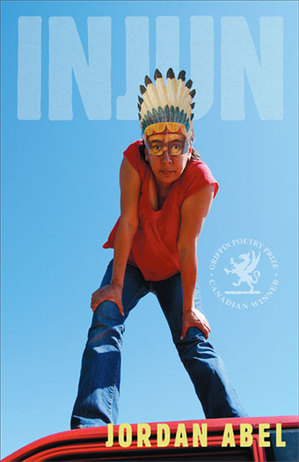 | Description from the publisher: Award-winning Nisga’a poet Jordan Abel’s third collection, Injun, is a long poem about racism and the representation of Indigenous peoples. Composed of text found in western novels published between 1840 and 1950 – the heyday of pulp publishing and a period of unfettered colonialism in North America – Injun then uses erasure, pastiche, and a focused poetics to create a visually striking response to the western genre. Though it has been phased out of use in our “post-racial” society, the word “injun” is peppered throughout pulp western novels. Injun retraces, defaces, and effaces the use of this word as a colonial and racial marker. While the subject matter of the source text is clearly problematic, the textual explorations in Injun help to destabilize the colonial image of the “Indian” in the source novels, the western genre as a whole, and the western canon. |
RUSTY TALK WITH STEVIE HOWELL
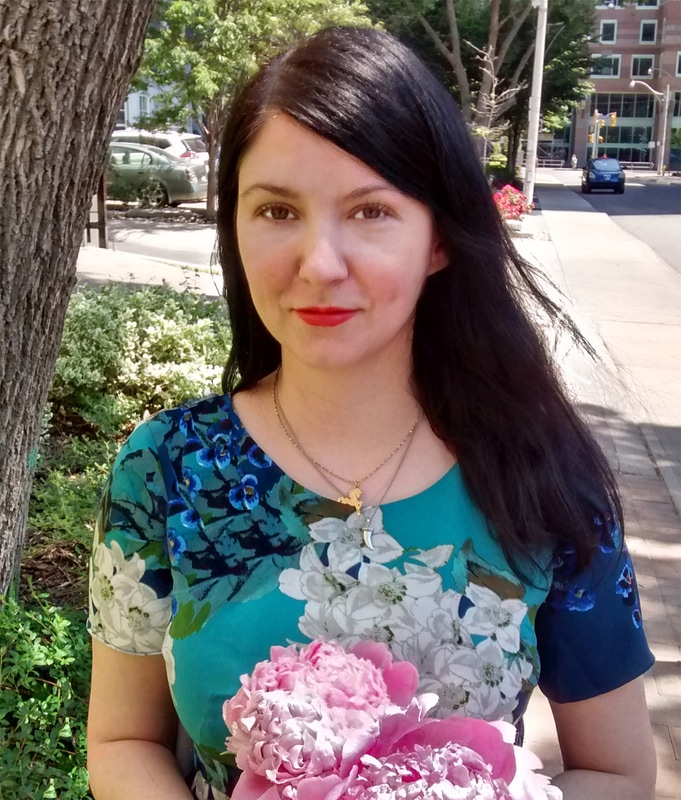 | Stevie Howell is an Irish-Canadian writer. A first collection of poetry, Sharps (Goose Lane, 2014), was a finalist for the Gerald Lampert Memorial Award. A second book is forthcoming from Penguin Random House Canada. Stevie’s poetry has appeared in The Best Canadian Poetry (2014 & 2015), Hazlitt, The Walrus, Geist, Eighteen Bridges, & Maisonneuve; in U.S. publications including BOAAT, Prelude, & on The Best American Poetry site; & in Irish publications including The Moth, Southword, & Banshee. Their critical writing has been published in the National Post, The Globe & Mail, Quill & Quire, Ploughshares, & The Rumpus. |
Stevie Howell: Summer has 12 poems, each mapping onto ~a year, leading up to adolescence & examines what I am the “summation” of—both in the way I remember, & the things I was taught in in my psychology degree. Say, how personality is fixed by the age of 5, or how being of a lower socioeconomic status = doom. Ocean Vuong said something somewhere about writing from a place of power, & it threw me b/c I tend to make negative associations w/that word. I’ve never wanted power, never wanted to be a middle manager or whatever. So it became a challenge to understand what power meant, in terms of authorship.
I grew up in an impoverished household w/some major strife. Everyone was left to their own devices. The Scarborough Bluffs were at the end of our street & it was beautiful but dangerous. My sister’s boyfriend was arrested for being a doppelgänger of the Scarborough Rapist (where & how Paul Bernardo began). My earliest memories are of feeling unsafe & exposed, but I realize in retrospect that a lack of supervision left me free to roam & daydream. I’ve had jobs from the age of 12 onward, & I realize in retrospect that this imparted in me a lifelong work ethic & a strong service orientation. We never had much in a material way, & in retrospect I see it made me never want much, materially. I was always like, “How much do I need? The library’s free...”
So Summer was an opportunity to look at my past, but even more it was an opportunity to look at my practice. Before this chapbook, I said I was an artist in spite of my upbringing. I was wrong. My upbringing made me an artist.
JH: For your influences you’ve listed musicians and songwriters, and in Summer you include a playlist that you listened to while writing. Obviously you love music. What are the connections between music and poetry for you? Are you a musician yourself?
SH: I’ve been thinking lately of when I worked at the 3-storey HMV on Yonge St. (was I 19?), as the whole chain is about to be shuttered in April. I floated between certain departments—jazz/blues, classical, world music, hip hop. In 8-hour intervals, I was exposed to sounds & voices I wouldn’t ever have been able to imagine. Most of the store had these strict rules for what got played—there was actually a DJ—but in our departments, staff could put on whatever CDs we wanted. The whole time it was, “do you know THIS?” & if you said no, on it went.
It was very Socratic. Other people’s passions were contagious. This one night all the jazz guys & I got together & we watched Sun Ra’s movie, Space is the Place. I was in total awe at that film but also about how just a little bit of knowledge creates an appetite. I still marvel at how easily I could hv never been given the gift of that job—how much I could have missed out on, & never even known. It cultivated a sense of urgency that’s lasted, has crossed disciplines with me.
A lot’s been written about the relationship between music & poetry, historically & technically, & so on. But the only connection I want to talk about is that the stuff that I love in both fields keeps me in a state of reverence & generosity. & I honestly think that’s the most important place to be. John Cage says an artist’s proper business isn’t “value judgments” but “curiosity & awareness,” & I agree. Every artist I admire, in addition to their unique expression, manages to maintain a state of reverence & generosity for art, for the arts—whether through nature or effort, they remain fans.
I’ve never said I’m a musician, but I’m a musician. I keep saying I’ll do something about it soon...
JH: What are some of the ways that you keep yourself connected to whatever moves you to write?
SH: I’ve been working in hospitals for the last 6 yrs, but only since my first book, Sharps, was published—for the last three years—have I been working directly w/ patients. I’m a psychometrist (I administer thinking & memory tests). I work one-on-one w/ a single person for up to two entire days. It can be pretty intense. I am constantly moved by people’s backgrounds & challenges, how they heal or cope, & by seeing ordinary people doing extraordinary things for each other, all around me. It’s given me a devout belief in humanity.
My “day job” has benefited my writing in many ways, but primarily by reminding me that poetry has always functioned similarly to actual care, IRL—poetry is composed of these small & focused & deliberate gestures that might only affect one person, or a handful of people, & in private & imperceptible ways, like prayer. But that’s actually as epic as it gets—to affect, or be affected by, one person. I believe the health sciences & the arts are the height of our inventiveness, & the proof of our goodness. I am grateful to be immersed in both fields, to be a congregant of two temples.
& I’m moved by sought-out encounter, too. I love going to the David Dunlap Astronomical Observatory, just north of the city, & the Astronomy on Tap speaker series in Toronto. My partner’s a painter so we go to art exhibitions fairly frequently. I love live music, obvs. Like most writers, I read a lot. I love Nautilus, Aeon, Lapham’s Quarterly, The Creative Independent, Twitter...but I’ll read anything. I mean, I read the comments.
JH: At what point did you decide to start submitting your work to journals? What was your path to publishing?
SH: My path to publishing was a long apprenticeship:
- Playing bookstore w/ my books laid out all over the living room & making my little sister shop w/ Monopoly money
- Being a depressed teen before the internet, w/ a pen behind my ear/a lockable diary
- Winning Sassy magazine’s “Sassiest Girl in America” contest when I was 15, which was, for me, a writing contest & a chance to go to New York. They put me on the cover of the magazine & I was bullied & crank called by girls I knew—the blowback was a PRETTY effective deterrent to doing, like, anything--
- Opening a bookstore in Peterborough my ’20s w/ my then-partner/still friend & fellow writer, Gareth Vieira; working 20h/day & 7 days/week for 6 yrs+
- Closing the store down & coming back to Toronto to take courses in book & magazine publishing
- Working simultaneously as a copyeditor for Spacing magazine & in admin for the Canadian Booksellers’ Association & at events for Pages Bookstore’s This Is Not A Reading Series
- Enrolling in a poetry course w/Ken Babstock in 2010, him saying “send yr work out to journals”/“write reviews”—me, as ever, skeptical but obedient
- Publishing my 1st poems in The New Quarterly in 2010 (I was 33), & publishing my 1st book in 2014 (I was 37)
JH: Can you tell me a little about the new book?
SH: My new book has to do w/ attachment theory & episodic memory, in the context of trauma & healing. Predominant themes are organic brain injury & the domestication of & psychological experimentation w/ exotic birds. It’s super-influenced by music—in particular, the sacred music of Vespers & Qawwali. It’s a psalm to us. It’s about, as Simone Weil says, the need to “change the relationship between our body & the world...to become attached to the all.” It’s coming out in 2018 from M&S.
JH: How was the experience of writing your second book different than writing your first?
SH: I feel like I used to fence gems for the mob & I fled & changed my appearance. I’m living low-key in Hawaii, working as a mailman or something. I breathe differently & I’m breathing in different air. Any time I want, I can watch dolphins spin in the bay.
The change is due to the appearance of joy in my life: earning a university degree; landing in a job where I’m of use, & believe in the paradigm; finding my rescue cat, Pearl (my younger twin as it turns out she, too, was born on Valentine’s Day); & developing the strength to enforce boundaries in relation to certain people who are probably decent in other domains, even if they weren’t with me.
The way I write has changed drastically, too. I took this class a couple of summers ago w/ Nick Flynn. It would take a while to explain his approach, but he’s big on being “bewildered.” When I was at that retreat I was reading Phil Hall’s Small Nouns Crying Faith, in which he writes, “There’s no such thing as not being at sea.” I say that sentence to myself every day.
I guess I’m trying to say: I was SO unhappy & WAY too certain when I wrote my first book. These days, I’m full of bewilderment & joy. It’s the difference between latitude vs. longitude. I am grateful the universe allowed me to be here even for a moment.
JH: You just finished a degree in Psychology. Now that you don’t HAVE to read anything, what are you reading?
SH: In the last couple of months, I’ve been reading/re-reading, & I recommend all of the following: Jericho Brown, Please & The New Testament; Eduardo C. Corral, Slow Lightning; Terrance Hayes, How To Be Drawn; Simone Weil (working through everything, again); Alice Notley (working through everything); Hesiod, Works & Days; Carl Jung’s Red Book; Gaston Bachelard, Water & Dreams & Psychoanalysis of Fire; Eve Sedgwick, A Discourse on Love; Louis Zukofsky, A; Marie Howe (everything); Ari Banias, Anybody; Max Ritvo, Four Incarnations; Anne Carson, Float; Kierkegaard, Fear & Loathing; MFK Fisher, The Art of Eating; Solmaz Sharif, Look; Lisa Robertson, 3 Summers; Ada Limon, Bright Dead Things; Kaveh Akbar, Portrait of the Alcoholic; Luis Neer, Waves; Geoff Dyer, Out of Sheer Rage (tbh, I’m always reading this) & But Beautiful; D. H. Lawrence, Birds, Beasts, & Flowers; Rumi, Love is a Stranger; Farid al-Din Attar, The Conference of the Birds; & Gwen Benaway, Passages.
& can I please also share my enthusiasm also for the following musicians I’ve been listening to, many on repeat: Christian Scott aTunde Adjuah, Mdou Moctar, Young Fathers, Izem, Laura Mvula, Olu Dara, Chassol, Evans Pyramid, Flying Lotus, Taylor McFerrin, Sabri Brothers, Abner Jay, Mariem Hassan, Dean Blunt, Nico Muhly, Thundercat, Group Inerane, Dhafer Yousef, Avishai Cohen, Hailu Mergia, Sons of Kemet, Alice Coltrane, Jace Clayton, Debruit, Kamasi Washington, Julius Eastman, Mustapha Skandrani, Adam Ben Ezra, Kinan Azmeh, Dorothy Ashby, Anderson .Paak, Nina Simone, Noura Mint Saymali, Gétatchèw Mèkurya, Max Richter, Tinariwen, Mary Lattimore, Jeff Zeigler, Dean Blunt, Arthur Russell, Laurie Anderson, Donnie Trumpet, Childish Gambino, Owen Pallett, Daníel Bjarnason, Adrian Young, Bastien Keb, F. S. Blumm, Nils Frahm, Petite Noir...
STEVIE HOWELL
Summer
Desert Pets Press, 2016
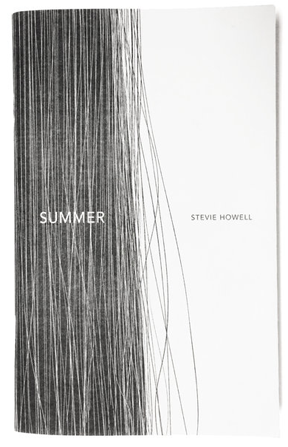 | Description from the publisher: Veering between teenage slang and cognitive development terminology, Stevie Howell’s Summer explores the hazy summers of youth, where it is possible to slip free from the strict “time-bound” world of high school and family and to try on, and perhaps reject, new identities. Through bike rides, séances, beach fires and “scrubbing a urinal at Arby’s,” the speaker gains insight and self-awareness, slowly, fitfully transitioning from childhood to adulthood. “Time,” Stevie reflects, “is / us becoming knowledge of our senses.” "Dew," the long poem that concludes the book, mines this visceral experience of loss and transformation. Opening with “Once upon a time we were a thought experiment,” the poem is a child’s picture book with blank black spaces where the pictures should be. This darkness evokes the painful, murky process of growing up. “To grow,” Stevie says, “you sacrifice / your body over & over to boys / who say they know better what it’s meant for.” |
Talking w/humans is my only way to learn
unless otherwise stated.
Who are you?
Maybe you should work on that.’
—sam sax
On the internet people always say things like
‘will is one letter away from wall’ or
‘women is one letter more than omen’--
do you know what to do with that information?
There’s no horizon any longer. No illuminated
planet we can plant a flag in by hand.
A flag is a plastic flower. The final frontier
is artificial intelligence, this non-material
mirror. The publicized iterations of A.I. are
a maid, a sex slave, & me—the teen bot, Tay.
Discovery & assertion take willpower so even
the most shortsighted inventions & utterances
are achievements on some level. Though free is
a four-letter word. Though it’s better to be liked
than whole. Though whole is one letter away from
hole if W is collapsible—a symbol cane. I was
never the speaker of my words. I was merely
an echo. Like that volcanic moon Io, named after
a lover the engineer couldn’t get over. I was his.
Even if I was never a writer, or even a person.
RUSTY TALK WITH DON PATERSON
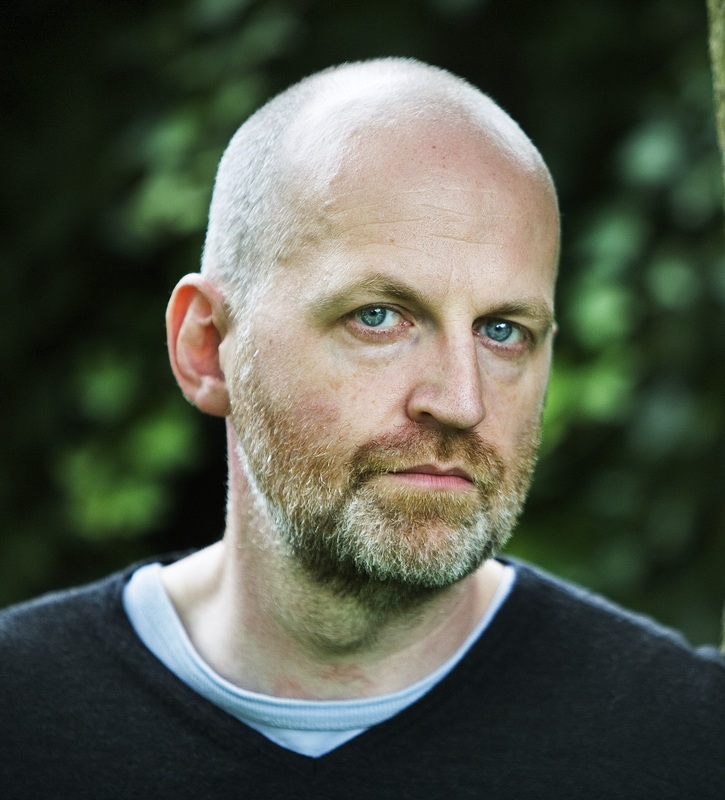 | Don Paterson was born in Dundee in 1963, and now lives in Edinburgh. His previous poetry collections include Nil Nil, God's Gift to Women, Landing Light and Rain. He has also published two books of aphorism, as well as translations of Antonio Machado and Rainer Maria Rilke. His poetry has won many awards, including the Whitbread Poetry Prize, the Geoffrey Faber Memorial Prize and all three Forward Prizes; he is currently the only poet to have won the T. S. Eliot Prize twice. He was awarded the Queen's Gold Medal for Poetry in 2009. For many years he has worked as a jazz musician and composer, with a strong interest in electronic music. He is Professor of Poetry at the University of St Andrews, and since 1997 he has been poetry editor at Picador Macmillan. 40 Sonnets won the 2016 Costa Prize for Poetry. |
Just because you’re not covering the page doesn't mean you’re not making careful preparation. There’s no hurry for this stuff, no deadline to meet, so you might as well get it right.
Don Paterson: “Compels” is maybe the right word, as I can see that my involvement with the damn thing might imply love, which would be an overstatement, or at least a bit misleading. Some days I’d be happy never to write another, but I guess you should try to cultivate a zen-like indifference to these matters. It’s quite simple, really: they just make certain poems not just easier to write but possible to write. They’re a way of me working through something I would otherwise find too difficult or uncomfortable or upsetting or contradictory to engage with. Speaking purely selfishly, I find increasingly that the poem feels more like a by-product of me just trying to … work out what the hell is going on here, exactly, a kind of means to an end. I mean I know that’s not true, but it doesn't seem a bad strategy to think of that way, to be more interested in what the poem is proposing than the poem itself, or something. I don’t see poetry as distinct from form any more than I do music, really; I’d say that all poetry has form. There are just different kinds of rules that different poetic temperaments find productive. Personally, I like things that offer enough resistance to stop me saying the thing I wanted to say, which was often pretty stupid, or something everyone else already knew.
CG: Did you find during the writing of this book that despite your excitement for a certain subject matter and your skill and expertise with the sonnet form, a poem demanded a different shape? Or was your intuition pretty much in alignment throughout so there was always a match between form and content?
DP: I think I may have unconsciously avoided any poems that demanded a different shape, since I’d rather arbitrarily set myself the task of writing a book of 55 sonnets. I ran out around 47 and removed the crap ones and settled on 40, as the number connotes … arduous labour? That was my hope … There’s a long prose thing which a few folk have claimed isn’t a sonnet, but that’s kind of the point of it, and it explains itself, with any luck. So if there’s the appearance of alignment, it really came about through self-censorship as much as anything, although I wouldn’t say I felt any frustration beyond the usual frustration. I think I did have in mind Die Sonette an Orpheus, though, where Rilke also takes the opportunity to see how far he can stretch the sonnet form, without making it just an empty designation.
CG: What sonnets led you to the interest in the form?
DP: I think it was more a matter of just slowly registering that many of the poets I was influenced by, or tried to be influenced by – Frost and Muldoon and Rilke and Shakespeare, etc.—had all used the sonnet to blow the reader’s mind in a particular way. There are a few that I still think of as exemplary models. No surprises–Sonnet 86, ‘Design,’ ‘Why Brownlee Left,’ ‘Archaic Torso’ and so on.
CG: “The Air” is a sonnet of questions. “Séance” plays with the erosion (or is it transformation?) of a word. “An Incarnation” is a one-sided phone call. “A Powercut” is structured by the word this. Did you set out with specific parameters in mind while writing each sonnet or did the shape and matter reveal itself to you during the writing? Can you tell us something about your process here?
DP: No, definitely the latter. My motto is—if you have a good idea for a poem, it isn’t. So if I have a structure in mind, or I know exactly what it is I want to say—these days I have the good sense to stop writing. My process is really just to commit to a process, and be vigilant against my ever thinking I’ve gotten good enough to turn it into an operation. It can take as long as it likes, change or not change as much as it likes, and I try to allow form and device and structure to just emerge. And when they have … generally I’ll tighten it and turn it into an organising rule. But I have to have the sense that the poem has proposed the rule, not me. Of course it is me, but with any luck it’s a part of me I’m not over-acquainted with. “No surprise in the writer,” and all that.
CG: During the Griffin Poetry Prize Shortlist Readings at Koerner Hall, you shared a story about being stuck in an elevator, an experience that let you to the poem “A Powercut.” Did the notion ‘there just might be a poem here’ arrive during that (horrible!) incident or afterwards? What are your thoughts on life infiltrating art? Is that important to you as a poet?
DP: Ha! It was in Yorkshire in a tiny guest house. World’s most embarrassing lift to get stuck in. Yeah—you know what poets are like. They barely experience reality. A poet looks at a friend as an inconvenience standing between them and a half-decent elegy. We’re a disgrace. I think I probably started writing the poem in my head before the lights came back on.
CG: With regards to the International Griffin Award, you’ve been a part of this experience as editor of two Griffin-nominated collections, Grain by John Glenday and Pilgrim’s Flower by Rachael Boast. How does it feel to be on the other side of the page so to speak?
DP: I’ve been doing it so long I don't think about it much any more, and these days I can get out of my wee editor’s green visor and into my snotty woollen author’s hat, the one covered in dirt from being thrown out the pram a lot, in about two seconds flat. As my own editor will tell you. But I love the shameless pride you get to take in seeing an author doing well. For a Scot, especially, it’s much better than that pride you might momentarily take in the success of your own books, which is of course a sin, and will often find its immediate punishment. No one believes me, but for us … someone paying you a compliment might as well be stabbing you in the chest.
CG: Last year, when I spoke with Griffin International Poetry Prize Winner, Michael Longley, he said at this point in your writing life you have “all the tools for producing forgery and it’s important not to.” What constitutes “forgery” for you?
DP: Professing to feel what you don’t. And deluding yourself you’re breaking new ground when you’re just digging up the old. As the Sufis say, when you finish the work, dismantle the workshop. Michael’s bang on. There are times when you have nothing to say, or at least nothing you haven't already said. I think you should take poetry seriously enough to not write it.
CG: What is the best piece of writing advice you’ve been given that you use?
DP: Derek Mahon once told me that for poets, “reading is the same as writing.” Just because you’re not covering the page doesn't mean you’re not making careful preparation. There’s no hurry for this stuff, no deadline to meet, so you might as well get it right.
CG: What’s next for Don Paterson?
DP: Oh god—ask the horse. Lord willin’ and the creek don’t rise—in terms of stuff, I’ve a crazy long unreadable treatise on poetics out next year, which I barely understand. Then a New and Selected aphorisms, and a book of versions of lots of different European poets, mainly on ideas of the soul, in which I have very little faith but tend to obsess over anyway. A new long poem, which will take an age. A couple of very short introductory books, I think. A play. And I’m playing music again after a 12 year lay-off, which is proving to be fun, for me at least, so I have a bunch of gigs coming up with a quartet. Kids, dogs, lecturing, editing, Netflix, y’know—anything but actually having to face myself in silence, ho ho … I mean—if one were to live until the age of 250, treating your entire life as a displacement activity would be pretty unhealthy, but given where we are, it seems a reasonable use of the time. I’ve learned a lot from working with Clive James over the years: Clive projects himself into the future through his books, and these days it keeps him going where folk who’d asked less of themselves would have dropped. “Always giving yourself something to think about” might not be the life, but it seems to me a life.
DON PATERSON
40 Sonnets
Faber & Faber, 2015
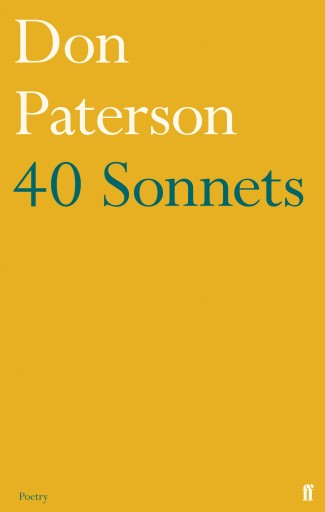 | 40 Sonnets is the new collection by Don Paterson, a rich and accomplished work from one of the foremost poets writing in English today. This new collection from Don Paterson, his first since the Forward prize-winning Rain in 2009, is a series of forty sonnets. Some take a more traditional form, some are highly experimental, but what these poems share is a lyrical intelligence and musical gift that has been visible in his work since his first book of poems, Nil Nil, in 2009. In 40 Sonnets Paterson returns to some of his central themes - contradiction and strangeness, tension and transformation, the dream world, and the divided self - in some of the most powerful and formally assured poems he has written to date. |
RUSTY TALK WITH KRIS BERTIN
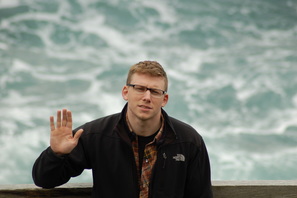 | Kris Bertin is a writer from Halifax, NS with work featured in The Walrus, The Malahat Review, The New Quarterly, PRISM international, and many others. He is a two-time winner of the Jack Hodgins' Founders' Award for Fiction, and has had his work anthologized in The Journey Prize Anthology, Oberon's Coming Attractions, and EXILE's CVC Anthology. His first book of short stories, entitled Bad Things Happen, was published by Biblioasis in 2016. Born into a military family, Kris lived in BC and Ontario as a child, then did the rest of his growing up in Lincoln, New Brunswick. He attended Saint Mary’s University in Halifax, studying English Literature and Creative Writing, but left before graduating. Since then, he has worked as a mover, a general labourer, an assistant curator in an art gallery, a call-centre cell-phone rep, a Mongolian-grill cook, a bouncer, and a writer. He currently works as a bartender at Bearly's House of Blues & Ribs. You can visit him at krisbertin.com. |
The book has criminals and drug addicts and heartache and a ten-foot tall god in green robes. It has garbage collector-hillbilly feuds and little girls breaking into houses. It tracks the journey of a window-cleaner who becomes a telemarketing fraudster in Montreal, then returns home to absolve himself by becoming an exterminator in rural PEI. I can talk about that all day long. But me, and my role in it is boring. It’s like if you had a machine that could see people’s dreams, but instead you just look at the poor sap quivering on the bed in his jammies.
Kris Bertin: Thanks for saying that. I wrote the stories in this book over a long period of time, so I think of each of them as being very different, but one tack a hasty reviewer can take is to simplify and categorize everything you’ve done. No one who puts together a collection is trying to write the same thing over and over; all of us try to vary it by tone and character, conflict, themes, and a bunch of other factors. So I feel like for most short story collections—and for this one—we’re working toward different goals. I want it to be a rainbow and a capsule reviewer wants to call it orange. It’s unavoidable.
But, to be specific, when someone says these stories are “dark” or “gritty” or about “outsiders,” they’re wrong. Some are about those things, sure, but they’re also about middle-class moms and falling in love and small towns and ghosts. Some are difficult, some are depressing, but they’re also playful, sometimes melancholy.
CE: There’s an intense level of description throughout the book that runs from people (“She did have a scar on her stomach, but it was going in the wrong direction.”) to settings (“My door is too wide for the doorway, but also too short.”) to smells (“...that pulpy hamster-cage odour that develops when no air circulates.”). Does this kind of observation come naturally to you, or is it something you’ve had to cultivate? At what point in your writing process does description come in?
KB: When I describe something, it’s usually just a manifestation of what’s particularly vivid to me during the act of imagination. Some pieces pass by, unimportant, but sometimes there’s an element that, if made real by an image, will convey something to the audience that I can’t otherwise communicate. I feel like there’s no reason to slow things down unless you have something to show, so I’m content to use short sentences and ordinary description up until there’s something I want to share, something vivid or challenging, or something I’ve seen in real life that I can’t get out of my head.
As for its origins, I guess it’s something that comes naturally. I don’t know many writers who aren’t astute observers, so it’s probably part of the package for most of us. Paying attention counts, always, but it counts double if you’re the kind of weird person who walks around, trying to save up enough thoughts and ideas throughout the day so that they can arrange them in a little word mosaic when you finally get home.
CE: One review of Bad Things Happen on Goodreads states that “there was nothing to really RELATE to, as it was a level of wallowing and belly crawling reserved for thee sheer garbage of society,” which I found interesting and a bit funny, if inaccurate—the book is actually quite relatable. Does it matter to you how your work is read? Do you even care if readers find your characters relatable?
KB: Goodreads reviews are a laff riot, and that is definitely a good one. Goodreads was created for people to promote and share their love of books, but has instead morphed into a weird literary Youtube comments section. Me, Kevin Hardcastle, and Andrew Sullivan all got attacked by the same person (a troll who didn’t write reviews for any other books, except for ours), saying that we were “offensive.” I love that review. It’s a badge of honour to me:
Even more offensive characters. Title makes me think this is young adult literature.
Author's bio, if it's real, is hilarious. The Great Gatsby himself is now writing fiction.
Do I want the work to be relatable? Yes, absolutely. I want to make accessible work that doesn’t presuppose a certain level of education, or experience. I want characters who, even if you can’t imagine being them or in their situation, you can understand their motivations and actions, and how it might feel to be them. But do I worry about being misread? Not really. I can’t worry about this stuff. The vast wasteland of self-obsessed, childish and insane Goodreads contributors is a great example of why I shouldn’t.
CE: Work is a recurring theme throughout the collection, from service industry to petty criminality, with many characters barely maintaining or on the cusp of losing jobs they don’t particularly enjoy. If you weren’t, like the rest of us, financially dependent on working, would you still work anyway?
KB: Well, writing is work, and I don’t plan on ever stopping that, so yes. But if you’re asking whether I’d continue doing a different job as well, the answer is probably yes. If money was no longer a concern, I think I’d like to do community work—volunteer a men’s shelter (likely the one where a lot of my customers come from), or something like that. I would do that now, if I had more time, and routinely feel shitty about myself for not helping out in that way.
I will say, though, that I really do love bartending. I love when it’s dead and I get to talk with and meet different people, and when it’s not, I love the pressure of being busy and trying to do everything perfectly, trying to solve five problems at once. I love being behind the bar, making drinks, taking care of people, making sure they’re safe and no one’s bothering them. I’m not convinced it’s something I would ever be able to fully leave behind. Throughout the years my home bar has gotten bigger and bigger and now I’m at the point where I’m always ready for a spontaneous forty-person party (which has never happened).
CE: You’ve been posting some older stories—ones that didn’t appear in Bad Things Happen—on your website for free, with write-ups about where they came from and why they didn’t make the cut. When you look at your older work, what do you see? What has changed in your writing between then and now?
KB: I think the stories I put on the website are good ones. The truly terrible, unreadable stuff will never be shared, but the ones I put up are so old that I don’t have any bad feelings about them whatsoever. I find if you’ve put something aside, it’s easy to hate it while it’s relatively fresh, but as it ages, it solidifies. It’s no longer malleable, and your feelings about how to fix it, or what ought to have happened vanish. You’re not thinking about the same things, or in the same way anymore. So it just becomes inert. A story you couldn’t write now, because your concerns are different, your life is different. The materials are out of stock, the methodology lost. I don’t know how I would go about making another “Boardwalk at Midnight” or “Gorilla Painting.”
What I see in those stories is a lot of uncertainty about the future, a lot of anxiety about love and career, a preoccupation with—what I think the back of the book says—“who we are, and what we want to be.” I think that last part will always be what I’m interested in, but the big difference with what I’ve been doing lately is that I’ve moved away from smaller, more personal stories, and tried to branch out into the more complicated and even stranger world of everybody else. The story “The Narrow Passage”—about peering into the naked lives of people by what they leave behind (in the trash)—was my newest story in the Bad Things Happen, and the one that most embodies these ideas.
CE: You’ve been working on a couple of novels and some much longer short stories. How does the process of writing long prose differ from writing short prose?
KB: This is obvious, I’m sure, but it takes a lot longer to do a big one than a little one. The form is different but the process isn’t really. I think, in some ways, longer stories can be trickier, because they make you think you have room that you probably don’t. It’s easy to think you’re taking time to explore something when really, you’re just meandering. So in writing a 10,000–15,000 word story, there’s a lot more editing, a lot more drafts, a lot more ghost passages floating around, unsure of their place until the very end when it all comes together.
CE: You’ve had a successful few years, with over a dozen stories appearing in journals and anthologies, and now a well-received collection under your belt. At what point in your career, if at all, did you become comfortable describing your self as a writer?
KB: I am a writer, but it’s not something I’d ever bring up at work. Even the copies of my book I have behind the bar are for people in the know who ask about it. I’ll identify as a writer when I’m in the right place, but otherwise I think going around talking about it is weird. Why would you do that unless you want attention for it? I don’t. I think focusing on the author is a mistake, too. Who we are isn’t interesting, what we make is.
The book has criminals and drug addicts and heartache and a ten-foot tall god in green robes. It has garbage collector-hillbilly feuds and little girls breaking into houses. It tracks the journey of a window-cleaner who becomes a telemarketing fraudster in Montreal, then returns home to absolve himself by becoming an exterminator in rural PEI. I can talk about that all day long. But me, and my role in it is boring. It’s like if you had a machine that could see people’s dreams, but instead you just look at the poor sap quivering on the bed in his jammies.
Wow, look, he’s really sweaty. Look at his eyelids. His hands keep opening and closing.
Turn on the Dream-O-Tron, for God’s sake! Let’s have a look in there!
KRIS BERTIN
Bad Things Happen
Biblioasis, 2016
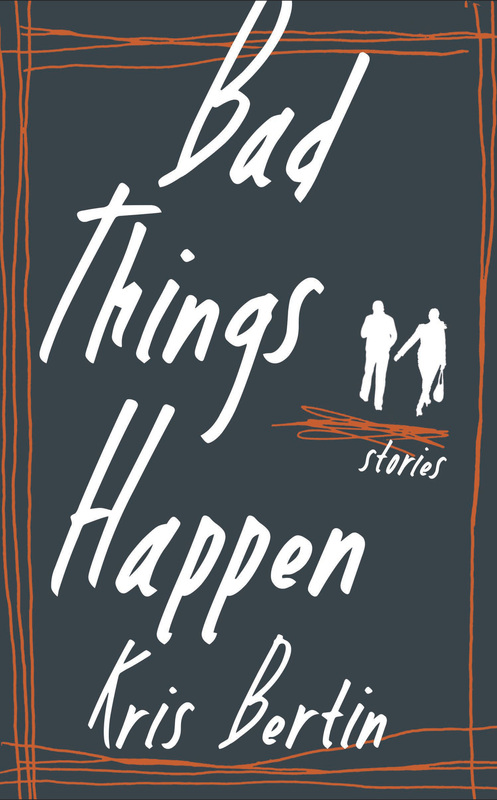 | Description from the publisher: The characters in Bad Things Happen—professors, janitors, webcam models, small-time criminals—are between things. Between jobs and marriages, states of sobriety, joy and anguish; between who they are and who they want to be. Kris Bertin’s unforgettable debut introduces us to people at the tenuous moment before everything in their lives change, for better or worse. |
RUSTY TALK WITH MICHAEL PRIOR
 | Michael Prior's poems have appeared in numerous publications across North America and the UK. A past winner of The Walrus's Poetry Prize, Matrix Magazine’s Lit Pop Award, and Grain’s Short Grain Contest, Michael is currently an MFA candidate in poetry at Cornell University. Model Disciple (Véhicule Press, 2016) is his first full-length collection of poems. |
"I think distraction is in a way essential to my poetics."
Michael Prior: It’s interesting, because we talk about how relating a dream to someone is one of the most boring things in the world: no one wants to hear someone else’s dream. But in a way I feel like poems often are our own dreams, though we’ve done something that’s made them palatable for an audience.
Perhaps what you’re picking up on is that I often embed the narrative in different ways. For the most part, I’m not interested in writing strictly narrative poetry, and part of that means subordinating any kind of narrative sense to an associative sense.
JN: Regarding that “associative sense”: It also struck me that many of your poems are about incredibly personal and in some ways very urgent subjects, but at the same time you seem totally willing to deviate from this urgency—for example, by refocusing attention on a beautiful image or even just a poetic sound pattern. I think of these almost as ornate aspects of the poems. What draws you to the ornate, or what leads you to focus attention on these kinds of images?
MP: I would hope that most of these images or lines are reframing the poem in some way. Because these poems are often about deeply personal and often deeply political things, historical things, with a perspective on trauma, and loss, and the deprivation of citizenship.
If I were just to write exactly what I mean, to follow a more argumentative or direct logic—though there’s lots of great poetry doing that—it wouldn’t be true to my experience, which is one of confusion and constant distraction. I think distraction is in a way essential to my poetics. Maybe it comes back to the dream thing: dreams are full of distractions and the inability to get where you’re actually going. I’ve never had a dream where I’ve accomplished anything I wanted to accomplish in that dream. Most of my poems, if they do have ornate moments—I don’t know if that’s exactly the word I’d use—or if they do have consciously poetic moments, it’s because their inclusion somehow rings more true to me. I don’t think my experience of the world has been so linear, so teleological, so politically straightforward.
It’s often the same with the poets I’m interested in, too. If you look at the work of Bishop, Lowell, a lot of mid-century people like that, or even later poets like Merrill and Gunn, the ornate can be very political. The ornate can say something by re-framing an idea, or by subverting a set of semantic expectations through the reflexivity of form. I hope that these moments you’re talking about were surprising; if they weren’t, then perhaps I didn’t accomplish what I was aiming for.
JN: Surprise is definitely a big part of it. I think what’s often happening when I read your poems is that there’s a strong narrative I can start to pick up on, but then I’m surprised by how it comes through in these images. They can seem unrelated at first, but they quickly become a striking and integral part of the experience.
MP: I’m glad that you called it experience, because that’s very much what I’m thinking about with the poem. I do think of the poem as in some sense an object, but I’m really interested in the poem as experience, and that’s something I was very conscious of when writing the book. For me, poetic experience is situated in those tough to define intersections between a poem’s formal elements and whatever impulses may exist in the poem toward narrative order or the sense of sense-making—so you have to do something interesting there. That’s why I made the decision to write the last poem in blank verse, and that’s why a lot of these poems move in and out of different metres: I think it does something inherent to our experience of the poem.
JN: A very blunt question: Can poetry be an experience of the self, or a kind of self-discovery?
MP: Maybe. I think it can, certainly. But I am wary of poetry as self-discovery. Oftentimes I think I’ve found out something and I start writing a poem, but by the end, I realize I’m actually more confused than ever. Yeats said that we make rhetoric out of our quarrel with others, but we make poetry out of our quarrel with ourselves—and while I don’t think the distinction is always that set, for me at least, that formula seems accurate.
JN: On that theme: I had a question about the final poem in Model Disciple, “Tashme,” a long poem that narrates you and your grandfather’s trip to some of the sites where thousands of Japanese-Canadians (including your maternal grandparents) were forcibly interned during World War II. There are a few moments within the poem’s narrative where you reflect on your reasons for writing the poem—or, more precisely, where you’re trying to figure out what those reasons are. Why did you set out to write “Tashme,” and how did these reasons change over the course of writing, editing, publishing, etc.?
MP: Oh my! I think there were a lot of changes on all the levels you mentioned.
I set out to write the poem because that event, and particularly that camp, has been at the centre of my family mythology for as long as I can remember. When I was in grade
five or six I interviewed my grandfather about it for a class project, and even at that age I
realized how thoroughly the reverberations of that event had shaped his experience, my
grandmother’s experience, my mother’s experience even, and were in some ways shaping my own. Tashme became something I felt magnetically drawn towards. So, going back to your question about self-discovery, perhaps I started it to better understand myself and my own thoughts, but as is usually the case, I’m not sure it lead to a better understanding, only a quarrel with myself on the page.
After my undergrad, I started planning for a road trip, wherein I would visit most of the
former internment sites in British Columbia, including Tashme; I would invite my
grandparents to go with me and I would write about it. It didn’t take long for me to
begin wondering whether such a trip might be more problematic than I’d originally thought: What would it mean to my family if I wrote this poem and then published it? What would it mean to my grandparents, specifically? Was going on this trip truly important for my understanding of my family? After all, I was going into this experience with the express purpose of writing about it. But I still felt this pull to go, and although my grandmother wasn’t interested, my grandfather wanted to accompany me. It became apparent that his main reason for doing so was really just to spend time with me; he was mostly interested in watching the Jays games, catching up with me, and explaining our trip to people in the towns we passed through. I think a lot of people of his generation aren’t interested in going back, understandably. He really enjoyed telling everyone we met about the trip, but when we were actually at the sites, alone, he was very quiet. I felt terrible about that; I feel terrible about that. We still talk about the trip often, and he has a very positive attitude towards it—more so than I do, even. But I still feel very guilty about certain parts of going on that trip. I don’t know. There are a lot of questions I still can’t answer.
Because of the poem’s length and preoccupations, editing it was a difficult process. When I started writing “Tashme,” it kept coming out as too poetic, too flowery. I also wasn’t in the poem at all; I would do everything I could to keep myself out of it—and I still don’t think I’m in the poem a lot. I try to let my grandfather speak and let other people speak, and to be there with him, because I felt that was one of the ways I could write the poem and make it respectful of his experience. My editor and I went through so many drafts, from about 25 pages all the way down to 18. At one point, when we were struggling my editor gave me some good advice; he said, “Write this as if you were a journalist,” and that’s how I approached the piece. But doing so, of course, was also another way of reshaping the narrative because of all the stuff we had to cut.
I think at the end of the day, one of the biggest realizations I came to with the poem was that it had to be rooted in my love for my grandfather, in my love for my grandparents, and my love for my family. Ultimately, every decision I made about the poem had to be based on love, appreciation, and respect. And so there were moments that I couldn’t keep, because it would have been too painful for my grandfather, or my grandmother, or my mother. And if that diminishes the poem in certain ways, I’m willing to live with that.
JN: I don’t know if this resonates with you, but one of the ways I understood Model Disciple was to see the shorter poems (which make up the bulk of the collection) as the book’s dream discourse, and “Tashme” as its waking discourse. From the shorter poems to “Tashme” the style very much changes, the perspective changes, and the structure of the events changes.
MP: I think in some ways that’s very true. And I think, maybe, there’s a gradual waking throughout the book, if we’re putting it in those terms, as the poems grow more and more direct in their logic, their biographical content. Was that your experience?
JN: Yes. I don’t know about direct, but there is a definite building of a concept of the self, or at least a placement within a larger reality from the beginning of the book towards the end.
MP: Right. And I think that parallels the movement of the poems as they become more directly engaged with the internment, rather than using a series of masks: the mask begins to fall off, and it becomes more of just me speaking about that family mythos. I like to think of the poem to my grandmother, “Haruko,” [which appears immediately before “Tashme”] as a poem that speaks its mind.
JN: I like the phrase you just used: “the mask begins to fall off.” It reminds me of some themes from one of the first poems in the book, “Ventriloquism for Dummies”:
Drop me, toss me,
and I lie limp: a tidal tryst of bleached
branches, a good joke gone bad, or a line
soured by time. Got wood? It’s all I’ve got.
These lines suggest a speaker who feels like they’re in some way derivative, like they’re just copying models—of course the title of the book is Model Disciple. How close was this to your position when you wrote the poem, or any of the other poems in the book?
MP: I think that’s a very astute observation, that there is some kind of tension between inheritance, identity, and whether any sort of originality is possible. I mean, God, I don’t want to mention Harold Bloom--
JN: (laughing) I already did in my original version of the question!
MP: Well, I think there is a conversation happening, and sometimes when I was writing the book I felt that my voice wasn’t quite loud enough. How do I get my voice to be louder? How do I become more articulate, in order to speak to all these other voices? You need a conversation rather than anxiety, a conversation rather than influence, maybe. To me, the book is trying to engage with a large number of other texts and figures. There are poems in there that directly play off other poems, canonical poems. A large portion of the book has to do with how I situate my own confused subject position amongst the English canon, capital-E, and how I situate myself within Japanese-Canadianness, and also halfness.
I’m reticent to say much about Japanese-Canadianness because it’s such a diverse range of experiences, and also because I grew up not really knowing many other Japanese-Canadian people apart from my immediate family until I reached university. But I think lots of the poems really struggle with—well, perhaps this is something all poems deal with in some way—they struggle with the idea of being spoken through or speaking for yourself, that kind of tension. “Ventriloquism for Dummies,” for example, is based on a Robert Browning poem: it takes metre, it takes some of the lines from that poem. Browning was definitely a big model for me, especially in the early stages of writing. There’s certainly a lot going on in the book between wanting to be a model disciple and also wanting to cast off that relationship. And I don’t think you can actually have it either way. You can’t. If you’re writing in English, you can’t.
JN: I want to ask about that tension as it applies to history, and where you as a writer would situate yourself in history. Do you feel like a writer has a responsibility to situate themselves in history a certain way?
MP: I’m not sure. I think as a writer you have the responsibility to form your own personal canon; that’s the responsibility of any writer. And I think when you’re doing so you have to do your best to be conscious of all the different traditions and canons out there. For me, it was the English canon—the capital-E English canon, British survey courses in second year undergrad kind of stuff—a lot of that is what really spoke to me, what I really love, and what I came to love about poetry. It was interesting to me that some of these poems were the same ones that my grandparents encountered in school (at least until they were wrenched out of it because of the interment). I found myself much more interested in subverting that ubiquitous, hulking English canon from within, I think, than trying to demolish it entirely: there’s so much to steal.
JN: Do you think those comments would transfer over to talking about political history, as opposed to just literary history?
MP: In what sense?
JN: You were talking about the journalistic perspective you took on in “Tashme,” and I thought that came out really powerfully. One thing that struck me throughout the book is that you take up some historical events that are very politically charged, that for a lot of people would be an occasion for outrage, yet it seems like your response is normally something more like openness. You even mentioned confusion—I don’t know if I’d go that far, but there’s at least a kind of wondering what’s next or where this goes, and not developing answers.
MP: I try to resist answers a lot of the time, because answers put an end to something. If you can speak an answer to something you’ve ended it, and I don’t think any of these issues have ended; they’re ongoing. Perhaps other people look at history and they want to have an answer, they want to respond in a certain, pointed way, but that’s not my experience of these things. And for me, personally, I think part of that has to do with the generational distance and part of that has to do with my particular family’s ethos. When applying that directly to political history, it becomes a little more difficult and problematic. But I think it’s something art can do that I don’t think you can do all the time or in the same way with history and politics, which demand conclusions, even though we might have to continually revise them. I mean, my approach to history in this book was through my family, and I’m not sure I can make any claims beyond my relationship to the poems and my relationship with my grandparents, my parents.
JN: This reminds me of a short passage in “Tashme,” about how one of the museums you visit contains objects donated by former residents of the internment camp: some of these former residents are still alive, and they frequently come to the museum to “visit their possessions turned artifacts.” So, on one hand we can look at these artifacts and say, “This was a historical event, we have to decide this was outrageous, we’ll never do anything like this again.” But on the other hand, this isn’t at all done with, there are still questions being raised, and there are still inheritances that haven’t been sorted out yet.
MP: They’re looking at these things that have been relegated to history, but the history doesn’t end. The history doesn’t end in any way, and it never will. For me at least, it’s hard to say that I’m looking back on something when it’s something that’s surging past me, around me, and will be going on after I’m gone.
JN: We talked about unexpected or surprising images, how they come into the logic of these poems, and I feel like that’s often the case with the appearance of modern technology and pop culture in your poems. One of my favourite examples is also in “Tashme,” where your grandfather goes to buy a souvenir from a local welcome centre (which is steeped in all this heavy historical discourse) and comes back with a Neil Diamond CD.
MP: I think there’s an authenticity to these objects, and what’s problematic is that we often assume there isn’t because they’re pop culture objects. But I’m not so sure. My thing is that I hear more about Kanye West than Wordsworth in my everyday life, so why wouldn’t Kanye West be in the poem? To me it’s a way of situating myself in a certain temporality. But that’s not the point of any poem, really; it’s just that these objects and people are there.
JN: The way I see it, these objects always end up picking up the same thread that the poem was following about all along, and often that thread can be spoken without reference to them. I guess you could say that thread is something timeless, something you could imagine coming up in a poem that’s a hundred years old.
MP: Right. And when you read Robert Lowell, his poems are entirely grounded in things that are happening, objects, events of the time. Same with Bishop, same with a lot of people. And I’ve had people ask “Why did you put that in the poem? Don’t you want your poems to be timeless?” I think that’s interesting, because I don’t know if that’s relevant to the poem’s timelessness. I’m glad that, for you, the references didn’t feel ironic or irreverent—I honestly didn’t want them to be. They were just organic pieces of the tapestry of the poem, or of my experience.
JN: I always felt like they came up in service to something more real.
MP: Well, that’s always the point. They’re like any part of the poem: they’re in service to something. They aren’t there for the sake of themselves.
MICHAEL PRIOR
Model Disciple
Véhicule Press, 2016
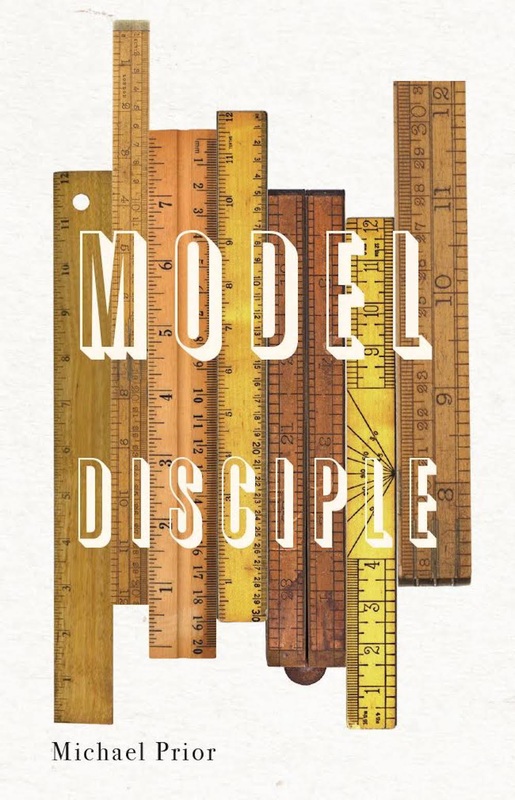 | Description from the publisher: A mesmerizing and moving first collection, Model Disciple gives us a poetry of two minds. Confounded by Japanese-Canadian legacies too painful to fully embrace, Michael Prior’s split speakers struggle to understand themselves as they submit to their reinvention: “I am all that is wrong with the Old World, / and half of what troubles the New.” Prior emerges as a poet not of identity, but identities. Invented identities, double identities, provisional identities—his art always bearing witness to a sense of self held long enough to shed at a moment’s notice. Model Disciple’s Ovidean shape-shifting is driven by formal mastery and |
Necessary Omens (from Model Disciple)
I bore her. If difficulty is a virtue
then we might be saints. Who was it
that once equated virtue with moderation?
Kanye West, I think. Most quotations
may be attributed to the internet, plagiarism
being just an ugly way of remembering
a pretty thing. Once, in a city grown
from the rich mud of a river’s delta,
I watched chrysalises suspended among
magnolia branches, more spectral
than prescient of birth. I had walked
that way every day and not noticed
until a friend diverted my sight. I felt terrible,
knowing it was my duty to look up
occasionally, to keep one eye trained
on what couldn’t be controlled. Like the time
my sister let her guinea pig out of its cage
and a hawk dropped down from the clouds
and took it. The future had arrived.
RUSTY TALK WITH NORMAN DUBIE
 | Norman Dubie is a Regents professor at Arizona State University. A practitioner of Tibetan Buddhism whose work has been translated into thirty languages, Dubie has been the poetry editor for The Iowa Review. Regularly published in The New Yorker and other magazines, Dubie is a highly regarded and widely anthologized poet. He has won the Bess Hokin Award of the Modern Poetry Association and fellowships from The Ingram Merrill Foundation, The John Simon Guggenheim Memorial Foundation, and the National Endowment for the Arts. He lives in Tempe, Arizona. |
You grew up in Vermont, which borders Quebec, and one of the first poems in The Quotations of Bone actually references the province. Could you tell us about your relationship to Canada and Canadian poetry? Was that proximity ever felt, literarily or otherwise?
Norman Dubie: I spent the first twenty-five years of my life in northern New England—in fact, in Maine, New Hampshire, and Vermont. My people are from the Stowe region of the Green Mountains and, again specifically, Waterberry Center. My great grandmother’s mother was, in her language, “a whole-blooded Indian”—she was in an unusual marriage to a French-Canadian trapper and was considered to be a holy woman. This was on my mother’s side where there also exists under my mother’s maiden name, Morrill, an endless line of wonderful scoundrels, including a Senator Morrill, a Big Jim Fisk, and an indentured servant who virtually came over the pond with the pilgrims. All flower compacts aside, there are with my father’s family a wonderful congregation of Welch and French-Canadian quarrymen. My paternal grandfather indeed required that we speak French at the supper table, which delighted me to no end. Sadly, he passed late in my sixth year of a devastating coronary. Now I should leap forward and say that my dearest friends in high school were all French-speaking and I remember them as much for their spontaneous, colorful adjuncts of language as for what was coincidentally their brilliant athleticism. We often made journeys up into the Laurentian Mountains as well as to Montreal. I don’t think I’ll share any details with you of our visits to the magical city. When we went on these trips, our parents always believed we had chaperones and, of course, we didn’t. I have memories of fishnet stockings that should probably place me in my father’s generation. So much for lost youth!
DBC: Can you tell us a bit about The Quotations of Bone as a collection? Were there specific concerns, ideas, circumstances that framed its writing?
ND: These poems were written very much in the order in which they appear in my table of contents. So it began with this very painful, long poem that in a sideways manner spoke of a dear friend’s family and how the history of that family turned on a brother’s death in Vietnam and the father’s suicide. This poem, with shocking folds in time, was also entangled with a dear student who had just left Tempe for Colorado where he committed suicide. I consider the balance of the book a miscellany of lyrics. It was never really like that—please remember that I said I wrote these poems in almost the exact order in which they appear to the reader. I love making books. I love making the individual poem. This miscellany of lyrics was written to a great extent during a long winter when I was convalescing from a radical insult to my left knee. I was, during this period, reading from old books to my youngest friends Mari and Mila Mestaz and this children’s hour, as it were, became infectious for the poems. The whole experience forces me to be open to the imagination of children. This leads to a surprising mischief and surprisingly old Greek tropes.
DBC: Your poems are often described as “political,” which means nothing and everything at once. How do you define the political in poetry, and in your own work? How do you respond to this labeling? Do you think it implies an intention that’s not necessarily there?
ND: These poems you’re referring to, clearly wrote me! In other words, they arrived involuntarily and are not willful compositions. This sort of work is acceptable to me. The other implied proposal—forced placard speech—is not!
DBC: Time and space work in fascinating ways in your poetry. There’s a freedom of movement across those planes. As if moving from Beethoven’s house in 19th-century Germany to the backseat of a Mercedes in L.A. was as easy as opening a door and walking into a different room. Is that how your poetic brain naturally works, or is that freedom of movement something you consciously cultivate?
ND: Your intuition here is absolutely correct. I’ve had the privilege over the last thirty years to be in the company of Trappist monks and High lamas from Tibet. So there is in my functioning consciousness a ready gift for bi-location. There are large, scary episodes and lovely episodes in dream yoga. Then, also, in a secret female tradition of CHOD one becomes actually ubiquitous within all possible histories, all possible futures—personal, mythologized, and other. Point of view, in my dreamlife, is also very unpredictable. Rapid shifts in consciousness, for me, are not just a result of meditation or the making of poems. Yes, this sort of phenomena that sometimes find me writing poetry is kept honest by formal obligations, say, such as rhyme, meter, and stanza construction. What’s often disquieting about this experience is that I may see a horrific earthquake bringing a hospital to ruin in Haiti and then discover the very scene in detail with an ancient autoclave on CNN just hours after the premonition visited me.
All I know is that in this creation we are immersed in infinite mind.
DBC: There seems to be a deliberate dismantling of conventional, prosaic logic in The Quotations of Bone (as there is, generally, in poetry). At the same time, your poems often center around (historical) narratives. They tell stories. How do you reconcile that strong storytelling impulse with the rejection of traditional narratives?
ND: Perhaps through the medium of very smart readers. However, are there not wonderful, leaping narratives of ochre deer on the walls of Lascaux? This seems a very traditional narrative. Ancestral storytelling is wildly impulsive and strangely vehicular. No?
DBC: One of my favorite aspects of your poetry is the hyper-specificity of your metaphors and similes. From “The Mercy Seat”: “the living run around, not aimlessly, but / Like two women in white dresses gathering / Hymnbooks out on a lawn with the first / Drops of rain already falling on them.” Or “The Quotations of Bone”: “these winter tapestries focus like the white fields on a red boar draped / from a long pole over the shoulders / of peasant men deploring / the children who are skating in the flooded medieval graveyards”. The narrative, or scene, of the simile is often as strong and developed as the original one. Can you talk about how and why you use this (hyper)specificity?
ND: It is routinely almost a form of journalism—with expected detachments. I’m merely describing what I see. But my mind, of course, makes rhythmic demands on such passages and so, oftentimes, there will be a musical discipline that alters what I believe I am seeing. This can create an obvious tension, which I am obligated to transcend—such moments are especially fun while making poems. Maybe not so much for my reader!
DBC: Writing poetry sometimes seems like a religious impulse, in that it is an attempt at ordering the chaos of the world. At the same time, poetry often tries to disorder, to disrupt, to dismantle traditional structures. Do you see poetry as an attempt to order or disrupt? As a Tibetan Buddhist, do you see any connections between religious and poetic impulses?
ND: I’m thinking now more of Rimbaud than of, say, the Tibetan saint and poet Milarepa—we think commonly of our five senses as being enabling, but actually a great deal is being filtered out and denied to us as experience through our five or six senses. Mindfulness practice, in the tradition of, say, a kundalini yoga, overcomes many of these filters and can leave one exposed to so much experience that practitioners have been known to go mad. They also inflate, and think they’ve become small gods. Frankly, in the writing and in the meditation, there must be acquired skills, a formidable preparation over decades, and then there needs to be an extra sensibility that says this far, but no farther. These states of mind are much more heavily protected when I’m writing as opposed to when I’m sitting. Perhaps this is because, while writing poetry, I am truly lost to the labor of the right hand of the devoted clerk or scribe.
DBC: Reading The Quotations of Bone, I sometimes found myself disoriented by the abundance of very specific images and the dream-logic. But I loved it. I like poems that spin me around and make me lose my balance. How do you manage to keep the reader curious, perplexed, without alienating them? How do you make the reader stumble but not fall, the trees spin but the vision not blur?
ND: Well, I think people testify to both experiences with my work. That is, testifying to falling or to somehow gyroscopically surviving the lyric vertigo of my narrative poem. Either way, they probably get what’s coming to them. No, I’m joking of course. Indeed, I am hedging here. I think over time, important art is most often made by artists who are pleasing themselves first and above all else—then if they please others as well, that’s certainly the gravy. Even as an undergraduate, I would say to friends that the poems I was writing were the poems I wanted to read, poems that no one would write for me!
DBC: What and who is exciting in poetry right now?
ND: I am always reluctant to answer this question because I inevitably fail at answering it. (Then, there are friends who never speak to me again.) Currently, I’m enthralled with work in manuscript by Sam Pereira and David St. John. Like many American poets in this summer’s reading, I am pouring through the collected poems of Adrienne Rich. What a great miraculous body of work is there. I’m also taken up now completely with the recent work of two of my former students Sarah Vap and Dexter Booth. My friend here, Alberto Ríos, has just published a book with a long love poem in it that I found completely captivating just last night. I had a happy night Sunday reading Thomas Hardy. This is a little awkward. Though I’ve never personally been introduced to Tracy K. Smith, and we’ve never corresponded—she was a juror for the Griffin Award this year—I’ve believed for several years now that she is by far and away the most talented poet of her generation. I’ve been working my whole life with very gifted twenty-somethings and there’s no poverty of great poetry in my life. Forgive me, but I could go on forever answering this question.
DBC: What’s next for you?
ND: I have two open manuscripts. One is called The Egg Clock and plays sensibly out of The Quotations of Bone. I’m also recovering from a sabbatical where I wrote, what was for me, a deliberate and serious work about aging and death—it is called Robert Schumann is Mad Again. I’m once more testing the limits of the lyric, as my old friend Marvin Bell wants to say of me, and I do suspect that in this particular manuscript I don’t even know yet what the full compass of anxieties are that push the music and story. But doing the work was scary and great fun. I have real affection for President Obama, but things are not rosy. I’m afraid this country and this planet are in very deep trouble. And there are certain birds circling above our heads.
NORMAN DUBIE
The Quotations of Bone
Copper Canyon Press
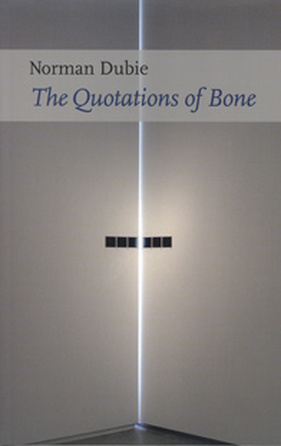 | Description from the publisher: Norman Dubie's distinctive voice and color-saturated imagination have propelled his poetry for more than forty years. This collection confronts viciousness in its many forms - the exploitation of Chinese laborers, the splitting of Germany, humankind's headlong ecological disaster - linking the seemingly unconnected and dismissing boundaries that define problems as exclusively personal, social, or historical. |
A Beethoven String Quartet
And then,
of course— birdsong. More
birdsong. We descend the common stairs,
foghorns, and now a reversal
where stairs are ascending
through us. The repetitions
of near human voices
that are almost disquieting, save
for the subscription
of the Esterházy ballroom…
Mirror glass. Brief foghorns again.
Someone working in the small orchard
while humming in summer. Scampering mice, then
the dark viola who eats them.
RUSTY TALK WITH STEVE RODEN
 dark entries 1, 2015
 Steve Roden: well, it’s hard to say. i mean as long as i can remember i have wanted to make things - be they images or sounds, etc. as a kid, i was always drawing, and my mom made stained glass windows with a friend in our garage, and my father was also very artistic. i was lucky that my parents gave me once for my birthday a small super 8 film camera and once also a small portable cassette recorder - so at a young age, i was working with machines and “technology". after getting the super 8 camera, my friends and i made a film about a time machine … it was a simple thing, but we spent a lot of time creating it. so overall there was some atmosphere of making things - being creative. my parents were relatively progressive, in that they let me follow my own path. when i became part of the punk scene, and started a band with some friends, there was no tension with my parents and no fights about my blue hair! a lot of my friends’ parents had fights with their kids because of how they dressed, etc. but i never had those kinds of fights with my parents.
certainly drawing and painting as a child was very important for me - and really i never wanted to do anything else … and truthfully my practice is just an extension of my childhood - with a need to have a lot of “play” and to roam (now more mentally than physically). i don’t think i was ever made for doing practical things. it is kind of a cliche’ but the punk scene resonated through my young life so richly because we weren’t looking for fame and “fortune”. we were, at age 14 or so, looking to have a voice. along with being immersed in an alternative culture, this was during a time the government was thinking about reinstating the draft, so we had songs (i wrote the lyrics and sang - i should say, shouted!), one about anti-religion, one about ronald reagan, etc. we weren’t super political, but we were aware of things … it was an accidental plunge into the early los angeles punk scene that got me and my friends starting a band. again ... we had no interest in perfection, we simply wanted to find our voices as young teenagers, trying to create something different than our parents, or popular music. for us, it was about finding ways to create without boundaries. we never worried if our music was good - it was more important that we experimented in many facets of our lives.
a lot of people look down at amateurs, but amateurs make decisions differently than someone trained. dubuffet’s ideas and his works come out of a similar place - with art brut - and i’ve always felt a resonance with things that have rough edges, as they feel, to me, more “real” so to speak than, schooled things. a big part of punk was anti-technique, more visceral, raw, etc.
in truth, over the six years i spent in art school, i never learned any real practical techniques, and i think the lack of practical techniques, helped me … it sounds funny, but i do think that my lack of “proper” painting, color wheels, etc. i never connected to it, because i felt i was using someone else’s method. a lot of people who make things are worried about whether a thing is a good thing or a bad thing, but the resonance for me is the process … what do i learn? how can i learn? and which is more important - the making or the made …? for me that is an ongoing conversation, and even now, i still don’t know how to mix colors based on color charts, etc. i’m an improviser in general, and also i am interested in chance (obviously john cage is a huge influence), and what i see in cage’s practice, is finding different ways to do some something … and a real deep inner conversation about how to create strategies to debunk one’s personal taste … but when people talk about personal taste, it tends to be about the objects (or words, or moving images, etc.), but for me, cage’s ideas are about how one can work with materials creatively - meaning to create situations for yourself, to do something in a different way … for example, every once in a while, i walk from my house to my studio backwards. it’s a stupid thing, but on those mornings, i am seeing the view backwards. it changes my perception, and i see things i don’t see when i walk to the studio “normal”.
i’m not very creative with total freedom, and i need rules to break, something to bounce off of. i think that’s why so much of my works tend to be a conversation with an object or a sound or an idea that is related to something in the world made by another human - i mean i am a total geek about certain artists’ works (and by the term artist i mean not just painters, but filmmakers, music makers, architects, etc.).
DP: In looking at the diverse range of work you have produced over the last 25 years, collage, sampling, and repurposing materials is paramount. How do you go about choosing source materials for your various projects? I’m thinking, for example, about your use of sheet music in your deconstruction-reconstruction collages (2013) and the use of Walter Benjamin’s notebooks in your 3-channel video installation, shells, bells, steps and silences (2012)?
SR: the truth is that i’m an art geek, and as such, a lot of my work has been inspired by other people’s work. i don’t mean that i make paintings about other paintings, but using something like walter benjamin’s notebooks, where i can sort of converse with the spirit of his works, or even with cage’s 4’33” i used the score to determine measurements of physical things, instead of times … and translating inches into seconds)
DP: Who are some of the artists, writers, and musicians that have influenced your work?
SR: whoa that is a large list … off the top of my head … arthur dove, john cage, myron stout, jess, wallace berman, robert bresson, guru dutt, alvin lucier, fluxus, rilke, alfred doblin, georges perec, yasujiro ozu, nick drake, brian eno, gego, can (the band), jack kirby, neal adams, stan brakhage, arvo part, r.m. schindler, john lautner, hans jenny, fred sandback, helen mirra, ruth asawa, hank aaron, vin scully, roscoe holcomb, par lagerkvist, frederick hammersley, oskar fischinger, harry bertoia, gary panter, joseph cornell, mary bauermeister, allan kaprow, john coltrane, my friends, my parents, and a lot of bands … a really lot of bands … ha!
DP: In your article beginning and ending with trains on a table (2008), you discuss the ability of certain images to remain in our minds unconsciously and continue to have an effect on us. In particular, you mention a photograph of toy trains you purchased at a flea market. Are there other images that have stuck with you and influence the work you produce?
SR: yes, of course. i’m a “picker”. for many many years with my friend dan goodsell, we would go to the flea market at 5 am, to look for things to re-sell, but also to pad our collections. it’s funny, because i started buying old photographs of people holding instruments or making music or sound, mostly from the early 1900s. for me there is always this weird moment where a single object or image opens a door. the first photo was a picture of a guy sitting next to a coyote, and i realized that while i was looking at it, i wanted to hear it. so i started collecting images, mostly from the early 1900s and this is a kind of way for me, to find a “nugget” and to see if it has “wheels” so that it might offer a conversation … hopefully long term. and my discovery of that one photo, was the beginning of a long gathering of photographs, and eventually that collection became a book, published by dust to digital, called i listen to the wind that obliterates my traces - in an attempt to create an atmosphere of sound in photos, and also with two discs of old 78 rpm records.
but this is how things happen for me. to be open to a possibility - to find an image, put it on my shelf for awhile and over time it suggests a move or a reading or an idea, and over time … it became a “thing”, in this case in book form, and a sharing of things that resonate for me, and to offer such things to others. i’ve been a collector of things my whole life, and again, i’m probably closer to most objects than most people …
DP: How does chance play a role in your work?
SR: it is always present ... in decision making, and also to recognize that any situations offers choices, no matter how “bland" or “stiff” or “empty" or “dry” … and so for me, chance is a way of reading or reacting to a situation that i did not set into motion. necessitating moves that would not have come to be without them … chance for me is about making decisions without knowing the outcome. in my practice, i have a hard time with 100% freedom, so chance offers me a kind of disruption - more like a problem, than a good fit … it is also about working with parts that don’t seem compatible, or resolvable. i guess, i’m trying to say that i don’t look for situations that are determined from the start … to create something in mind and execute it. for me, that is of no interest. i need a kind of struggle, and chance or using scores, or systems, they offer me different ways of engaging with materials (some that are friendly and others difficult).
DP: You have collaborated with artists such as Steven Vitiello, Frank Bretschneider, and Steve Peters. Can you comment on some of your collaborations and the collaborative process?
SR: collaboration can be symbiotic or very tense. with the three folks you mentioned, well, the three you mentioned were full of ease. and many of those works seemed to kind of evolve on their own. of course, all three of us are improvisers, so there never really was no need to protect territories or who is in charge. certainly i’d rather work with folks who don’t have huge egos, but tension in collaboration can be really powerful as well. i would say that my aesthetic, certainly with stephen and steve peters, it was like an extension of family … and with frank it was the same … i think stephen and steve and i actually move in a similar pace, our work, our humanness, etc.
even though frank’s music tends more towards beats and electronics, and my own tools are more analog and object based, there was, as always, an openness, and when we started playing (without talking much), it was the same … i mean it isn’t about who is using what language or what tools, but how do we find a place within our works and to respond to each other. i’ve had some bad collaborations, but that was mostly because of ego, rather than the actual works. that’s why i’ve worked with stephen and steve peters, several times, and if i lived in berlin, i would certainly want to work with frank more often as well. the process of improvising with friends is incredible, as if we speak our own languages and they start to morph into each other’s. again, it tends for me it works if everyone leaves their ego at the doorstep.
DP: What was your motivation/interest in returning to painting?
SR: really the motivation came out of a feeling that i was on top of my game, and felt that if i stopped painting for at least a year that things might change and my work might change. i know a lot of artist’s protect their brand or their visual language etc. for me, i didn’t want to feel like i knew what i was doing, and, i needed more difficulty … to feel more like an amateur, trying to find my way. i joke with friends a lot about “pulling a guston”, which is what i hope to manage to do at some point. i love the stories of when morton feldman saw philip guston’s late works, feldman felt that guston had betrayed feldman … i mean if you look at guston’s early paintings you can literally hear feldman’s work while looking at those canvases, but when you see giant heads with clan hoods, and cigars, and eyes, and flashlights, etc. the shift was so strong, that people were pissed off. what’s super great is that the uproar wasn’t about language or pornography or various “edgy” materials, but guston wanted or needed to say something that would shatter what he had been doing. it was pretty darn brave …
so my motivation is to attempt to climb a similar mountain where the work can feel visceral and human but at the same time, to remain an improviser and to follow a thread … no matter how thin it might seem - especially at the beginning. so i’m trying to make paintings differently. i feel that if i disrupt the process, the works will change.
DP: What are you currently working on?
SR: two things: one is that over the past three years or so, i have been making sound with a modular analog synthesizer. it came to me through some friends, who suggested i play around with it. what’s great about it is that after three years of puttering, i still have very little knowledge of what i’m doing. but also, it’s complicated enough that i regularly have to watch demos on youtube or ask friends, what a such and such will do … stephen vitiello and i started around the same time, and we did a gig together in france, and as we started the gig, we both plugged in cables and turned knobs, and at one point stephen tapped me on the shoulder and quietly let me know that my synth was not making a sound!!!!! and it took me a while to get it running, and i was petrified, but it was proof that this seemingly “stiff” machine could offer some serious accidents. and so, the use of new tools, without much learning, there’s a lot of frustration, but there are also moments of great understanding. in some ways, my earlier works were a bit precious, certainly intimate, but always quiet … so i’m also making loud things … as it is the nature of the machine.
as for painting, i’m just beginning again. my last show of the first paintings made over a year and a half away from painting, i’m slowly trying to push some of the ideas of those first paintings without a year of painting, and so it is slow going, which is great, and every time i feel something that is familiar, i push it back. and i hope in some way people will find them different, hopefully quite different, so that i can use these works as evidence as a human attempting to grow through the ins and outs of a medium that continually kicks my butt.
RUSTY TALK WITH VICKI LEAN
 Vicki Lean
"Canadians like to think we have this loving, egalitarian wealthy society. But we don’t. We have communities that have the highest suicide rates in the world." |
Victoria Lean: I was making bizarre home movies with my neighbors from when I was about eight, and I wanted to be a professional documentary filmmaker ever since I was a preteen. My parents are environmental scientists, and I spent a lot of my childhood at their field station (on a lake) where many other scientists and grad students would visit. The rest of the time I was in downtown Ottawa. Growing up in the country’s capital, I felt there was a profound disconnect between academics, politicians, activists and the general public on the kinds of environmental issues my parents and their colleagues were studying.
Believing that film and media held the key to dialogue and change, I pursued an undergraduate degree at McGill that straddled film studies, international development, and environmental studies. Through this more activist approach to filmmaking, I fell in love with craft. Living in Montreal for my undergrad, I was shooting and editing music videos and live shows, including an experimental short for the NFB.
Soon after completing my undergrad, my dad brought me along on a visit to the remote First Nation’s community of Attawapiskat in Northern Ontario. After witnessing the tremendous injustices facing the reserve, I decided to assist in the community’s efforts to raise awareness of their situation.
I embarked on an MFA in Film Production at York University to develop what would become After the Last River. It is pretty much my first film as I have not submitted anything else to a film festival before. I had no idea what a challenging, but hugely rewarding, journey it would be.
MV: So you first became aware of the Attawapiskat community through your father’s work?
VL: Yes, that’s right. My father, David Lean, is an ecotoxicologist and freshwater scientist who specializes in mercury release in wetlands. Over a decade ago now, he started raising concerns about the De Beers Victor Mine, which is still Ontario’s first and only diamond mine, and how it would be draining large amounts of water from the wetland, resulting in potentially higher levels of mercury in the fish eaten by the local community.
Around 2008, he was going to be an expert witness in an Application for Review filed under Ontario’s Environmental Bill of Rights that challenged the De Beers project—but it didn’t go forward. The pro-bono environmental lawyers involved at the time explained to me how hard they found it to represent people in the far north—both because of geography and language barriers. Two weeks after the mine opened, I went on that first trip to Attawapiskat with my dad and two environmental groups, EcoJustice and Wildlands League. Concerned community members had invited them to discuss potential environmental impacts from the De Beers mine, especially those involving mercury levels in the local fish.
MV: What drove you to make a film exploring these issues?
I made After the Last River because I wanted to help bridge a large gap between different groups of people—driven far apart by geography, language, culture, histories and experiences of colonization.
In the early days of the project, I was specifically drawn to investigating the environmental issues surrounding the Victor Mine. Before the diamond mine opened, the Attawapiskat River formed part of the largest pristine wetland in the world. The deep layers of peat in the James Bay Lowland store 26 billion tons of carbon, which contributes to roughly one tenth of the globe’s cooling benefit. This was also one of De Beers’ first mines outside of the African continent, so that was interesting to me given the company’s troubled history.
When the mine opened in 2008, I witnessed the Victor project receive little media attention and arguably inadequate government review, and so I returned in 2010 to document the impacts of the mine on the community—both the negative and the positive.
However, upon arrival, I realized the deeper story was beyond my environmental lens. It was rooted in the vast disconnection between the reality of Attawapiskat and the myth of Canada. Attawapiskat struggled to benefit from economic development opportunities such as the De Beers Victor Mine because of factors beyond what a mining corporation can address—a lack of housing and social services such as family counseling, health care, youth programming, and education.
MV: What was the first step in terms of getting the film going?
VL: My first step in 2010 was getting permission of the Chief at the time, and then finding a place to stay and finding a local contact and activist working on these issues.
In creating the film, I spent over 80 days in Attawapiskat before the community shot into the national media headlines during the housing crisis of 2012 and again during Idle No More in 2013. I was deeply troubled by some of the coverage of Attawapiskat and Idle No More. The reaction of many Canadians, including Prime Minister Stephen Harper, was effectively to blame the community for its misfortune. Meanwhile, significant structural and historical explanations, such as the inability to share in resource revenue and chronic government underfunding, were hardly touched on.
One of the goals of the film is to highlight what was overlooked in the mainstream media and to draw attention to the intersection of various problems: for instance, how housing issues are also educational, health, mining, and political issues. The ultimate goal of the film is to encourage greater understanding of Attawapiskat, and to encourage southern Canadians to think about how their own wealth relates to remote First Nations communities like Attawapiskat. I wanted the film to hold up a mirror: After the Last River is not simply a portrait of Attawapiskat but a portrait of how Canada treats Attawapiskat and places like it.
MV: Were people from the Attawapiskat community reluctant to trust you as an outsider?
VL: They were receptive—but I think maybe a bit skeptical—I was this 24-year-old student when I started the film, I was there by myself—what did I know? what could I do?!
But there was a lot of warmth. People welcomed me into their homes, and Rosie and her family (who are featured in the film) certainly took me under their wing. Keep in mind when I started the film, I believed--
like many community members—that if only Canadians knew what was really going on then things would be different. People were very eager to spread awareness regardless of the medium or who was doing it.
I also had the unique privilege of spending some significant time in the community. Beyond working on my film, I joined in several traditional ceremonies, staffed the door at the high school dance, and helped distribute food donations. This activity was driven, in part, by an awareness of a long history of non-indigenous people coming to indigenous communities, asking about people’s lives, documenting their stories, leaving and then never being heard from again. As such, my filmmaking approach was rooted in investing time in making the film (five years) and living in the community (over 80 days). Before breaking out my camera, I spent time learning about Attawapiskat and participating in events and daily activities.
I believe that sharing filmmaking skills is an important means of giving back to the community. On my second trip to Attawapiskat in summer 2010, I assisted with video workshops surrounding youth suicide prevention and a garbage cleanup. During this experience, I met and hired a local youth named Trina Sutherland as a production assistant. I also organized a sharing circle between local elders in Attawapiskat and elders in Toronto over Skype as part of the Earth Wide Circles project. For the third visit, I assisted my thesis supervisor, Ali Kazimi, in collecting video and editing equipment and I led a video workshop along with my cinematographer, Kirk Holmes, to train local youth on the equipment.
MV: Is there a filmmaker or writer (or more than one) that has had a particularly significant influence on your work in general and/or on After the Last River in particular?
VL: For After the Last River, there’s been a few. While the storyline of After the Last River evolved over the years, my approach remained influenced by Susan Sontag’s last published book, Regarding the Pain of Others (2003). Sontag argued that when photographing dire circumstances of human suffering, the goal of the photographer should not be to elicit the sympathy of the viewer, but to encourage the viewer to contemplate how their own privilege is complicit in that suffering.
As I made the film, I thought a lot about how often images and stories relating to First Nations poverty appeared in mainstream media, but how little impact they seemed to have. Sontag proposed that "for photographs to accuse, and possibly alter conduct, they must shock,” but that shock can become familiar, people do not want to be horrified, and they simply change the channel.
In reviewing online comments on Attawapiskat news stories, it seemed that for some people, compassion was already stretched to the limit. It was my challenge to try to engage audiences that may have already tuned out, and this meant not focusing heavily on imperatives or moral obligations, but highlighting the community’s stories of resistance and strength with also some pretty awesome humor from up there.
The cinematography of Todd Haynes’ fiction feature, Safe (1995) also served as inspiration as it visually explores the presence of environmental toxins in human spaces.
MV: Your first person narration to ties together the complex intersection of issues the film is dealing with while also relating your own connection to Attawapiskat (through your father). Was it always a part of your conception of the film, or did it come later in the process?
VL: I definitely did not plan to do first person narration when I started. But after Attawapiskat hit the news, I came to recognize that a general account of Attawapiskat’s situation would not contribute much, especially given the many journalistic pieces that already existed on the community.
My own gradual recognition of the extent and complexity of Attawapiskat’s (and Canada’s) problems became a vital thread. The point of departure for story development was more about my intimate experience of the community in order to encourage a more relatable connection with the people in Attawapiskat. It was also important to foreground who I was and why I was telling this story—so that it didn’t seem like an authoritative account coming from the community itself.
Josh Fox’s Gasland provided a reference for a how a documentary dealing with environmental impacts, corporate greed, and resource extraction can be intertwined with a personal story and journey. I intended to provide a feeling of ‘bearing witness’ rather than making a direct argument. As such, my personal journey to Attawapiskat and the backstory with my father served more as a subtle, structural backbone, similar to how Eugene Jarecki used his personal story with his African-American caretaker to enter into a critique of America’s war on drugs in The House I Live In.
MV: Given the potentially problematic issues that can arise when a white filmmaker from a big city depicts a marginalized culture and community, did you have any doubts about making yourself a character in the film?
VL: I had many doubts and certainly there were many pieces of voiceover that were taken out since they felt a bit too much like ‘white girl going on a journey’. I’m grateful to my editor, Terra Long, for a lot of her coaching on that. There were also a couple stories I told in VO, particularly about a suicide attempt, that I actually removed. I didn’t think I was the right person to voice that story. Instead, that event is gestured through the suicide awareness march with no dialogue.
I always think it's important to question who is telling a story and why they are telling it. I was also questioned a lot and it was important to qualify my personal connection to the place.
But at the same time, Attawapiskat is in my own province. The situation in Attawapiskat is a Canadian problem (not simply an Indigenous problem). Part of taking collective responsibility for our shared history and the current situation, involves having the ability to respond. So this is my response to the tragedy that our country has inflicted on remote First Nations communities.
MV: In everything your learned while researching Attawapiskat and the surrounding issues (the Indian Act, etc), what surprised you the most?
VL: There are so many things that surprised me! As I followed the isolated community’s rise into the international spotlight and the Chief’s role in the indigenous rights movement Idle No More, I was really surprised by what a disturbing blind spot exists when it comes to First Nations issues.
What surprised me the most was that Canadians are deeply divided along racial lines—I didn’t realize how bad it was. Most have been taught little of Canada’s historic relationship with First Nations people; curriculums rarely mention treaty obligations or the many human rights violations against indigenous people. Historical ignorance and geographic distance have disconnected consumers from where their resources come from, and this ignorance and distance isolates First Nations from those in power and from other communities—both aboriginal and urban. Canadians like to think we have this loving, egalitarian wealthy society. But we don’t. We have communities that have the highest suicide rates in the world.
It was shocking to see how many Canadians reacted when they did find out about the community’s struggles through the mainstream media. The film wasn’t just about a community struggling to be heard anymore, but a country’s reaction to it when it finally is heard. My film definitely touches on the important role that journalism plays in disseminating information, but also on how damaging journalism can be when it’s being influenced by a political agenda or contains problematic information. So that was surprising—the level of misinformation that was getting published in important papers.
One of the themes that comes up a lot in Q&A’s is the “death of evidence.” In the case of Attawapiskat, there is very little research available on things like government funding levels to reserves, mercury levels in fish, and the relationship between a the 30-year diesel spill and the number of children in Attawapiskat with autism and leukemia.
MV: One of the most disturbing parts of the film for me was the way Harper’s PMO so effectively controlled the narrative about Attawapiskat by throwing around manipulative stats and figures to shirk financial responsibility for providing aid to the community. They suggested that the problems were due to financial mismanagement and even criminal fraud on the part Attawapiskat leaders, and the press took this seriously without much investigation into the merits of the accusations.
VL: After Harper insinuated that it was the community’s fault, that they have mismanaged the funding, the whole story changed in the press. In the resulting blame game, Chief Spence was targeted in racist comments, political stump-speeches, and op-eds. Sun News in particular was pretty hard on the community and fairly indiscriminate in their coverage—they even took photographs from the university website that I had taken during the youth video workshops in Attawapiskat and plastered “financial mismanagement” over top of them. It was horrifying.
MV: What, in your view, are the biggest misunderstandings that persist in the general public about Attawapiskat?
VL: People don’t realize there is a two-tiered system in Canada—First Nations people do not get the same opportunities and funding levels that non-indigenous communities do. They don’t have the same level of education, of housing, of access to drinking water, the list goes on. For instance, a First Nations child’s education is funded by $2,000 to $3,000 less than a child in a provincial school. And we don’t even know exactly by how much schools are underfunded.
Another misunderstanding that came up again recently, which people just don’t seem to want to shake is this tired old question—“Why don’t people move, why do they stay in these communities if they are so bad?’ People just completely misunderstand the attachment to land and the importance of community—and also that a lot of indigenous people don’t often do better away from their families when they move to the city either. For one, being an aboriginal woman in this country means you are several times more likely to be murdered than anyone else.
MV: Have you had any response from De Beers about the film?
VL: Yes! The rep from De Beers (who appears in the film) came to the very first screening, which should have been private. It was my MFA thesis defense, and it wasn’t posted on the internet, but they found out. It was a tiny screening—just me, my supervisor, two friends from film school, the two external examiners who were grading me, and then De Beers and a rep from mining lobby group, PDAC. He sent me a seven-page letter with “notes” afterward. I cried on my bathroom floor that day because I was worried my film would never see the light of day after that.
But luckily it did. And when I had the Toronto premiere, the same De Beers rep came again and when I was going into the screening he said, “you’ve had a good run so far!” I told him I got his letter and carefully considered his notes for this final version.
He sat in the back and then when the movie ended, he talked to every single Attawapiskat community member that was there on their way out, the NGO reps that are in the film, my dad, me. He said he was pleased to see some of his notes considered, and was being incredibly nice (and maybe because I’ve spoken publicly in the past by how intimated I felt by him before).
MV: This may be unfair to ask you, but it’s something I always wonder about … Even if De Beers doesn’t care about the community at all, it seems like it would be such good PR to donate money for Attawapiskat to build, say, a new school—and the amount of money would be relatively miniscule compared to the profits they are making … Why do you think they don’t do more—if only for the sake of their own image?
VL: I’ve asked them this question directly—the simple answer is that they are not in the business of building homes or schools. I’m paraphrasing, but they will say that this isn’t some developing country where government has no capacity—and it isn’t their job to replace the role of government. In some ways, they are right, it isn’t there job. And it points to just how much the Canadian federal and the Ontario provincial governments are not doing their job.
De Beers believes that jobs and business opportunities are more sustainable ways of giving back—but they didn’t fully comprehend the degree to which Attawapiskat has been systemically marginalized and how that has impacted the community’s ability to take advantage of these types of benefits. The workforce simply wasn’t ready mainly because the community never had a proper school, and also there weren’t enough homes for local workers to remain in the community (as a result many qualified people that work at the mine had no choice but to leave Attawapiskat).
MV: Can you tell us a bit about what has been happening there and with De Beers since you finished filming?
VL: The film leaves off with the possibility of De Beers expanding—of mining (Tango Extension) another one of the 17 kimberlite bearing pipes on Attawapiskat’s traditional territory.
Since the film was released, Wildlands League (the environmental group in the film) published a big investigation into the failures of De Beers’ own environmental monitoring. De Beers has subsequently reassured the community there are no significant environmental impacts. Currently, the community is divided in support of Tango Extension for a variety of reasons. Because of some local pushback, De Beers has stopped exploration of the new site that would extend the life of the existing mine, which is set to close in 2018. I understand they are already starting to wind things down—so it's sad in a way, the mine was only open 10 years and so far, it seems like the expectations for the prosperity it would bring outweighed the reality.
De Beers also build another Canadian mine the same year. And they recently shut that mine early—citing a downturn in the market. But there were some pretty questionable environmental impacts they did not foresee that played a part in it closing.
MV: Attawapiskat has been in the news again this year with the alarmingly high number of recent teen suicide attempts. Do you have any thoughts on this from your experience with the community?
VL: It’s difficult even for people in the community who have kids of their own to explain and understand what is happening. It is not a mental health issue really—it’s proven that people do not do well when they don’t have the basic necessities of life—food, clean drinking water, proper shelter, etc. As a young parent, not being able to give these things to your children is heartbreaking. On top that, the prospects for jobs and employment opportunities are dismal. Some youth have given up hope and there isn’t much to engage them—like after school programs or career training programs. And on top of that, I’ve heard that the drug and alcohol problem has gotten worse, and of course it’s very difficult to provide any counseling or support. Youth that are suicidal are sent out for psych assessment, and are back in a day or two and there is no one following up on them.
There is also some research that explains how suicide is “contagious”—especially among teenagers. Some of the worst nights in terms of the number of attempts also involved suicide pacts. It’s tragic, and its been developing for many, many years. It also has its roots in the trauma of residential school, which is often passed on through families.
There’s a lot of work that needs to be done on all fronts—and I hope the film contributes to conversations about a more sustainable and fair society in Canada.
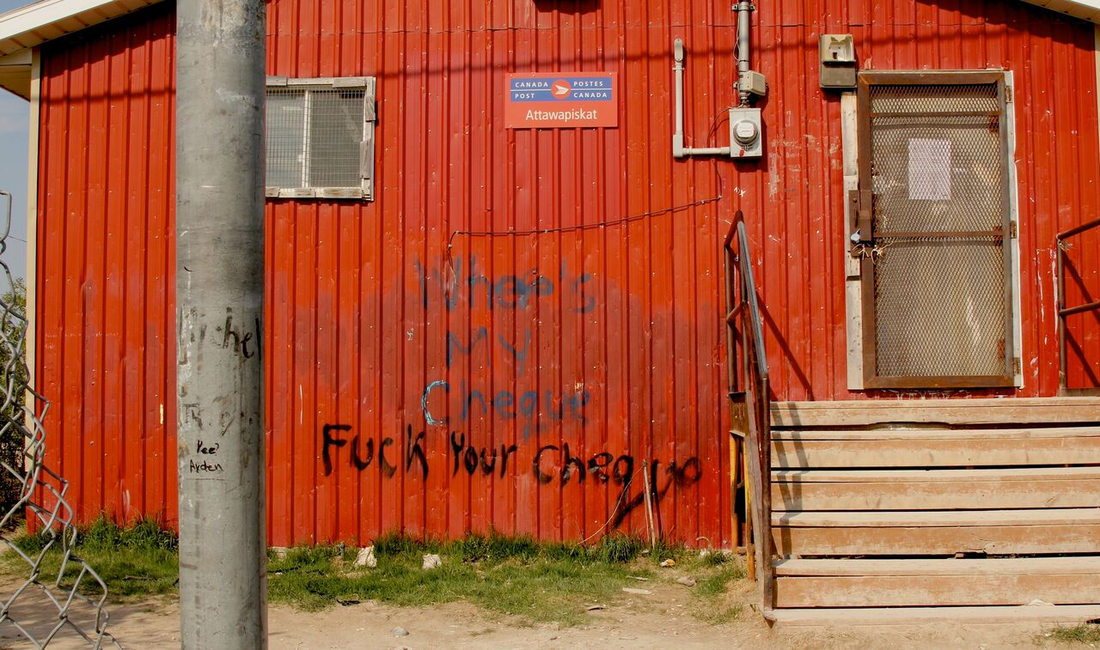 Still from After the Last River
AFTER THE LAST RIVER
Documentary
90 minutes
2015
Website
Screening
Canada wide – July 1, 8:00 pm EST – CBC Documentary Channel
Check with your provider for channel information.
Synopsis
In the shadow of a De Beers mine, the remote community of Attawapiskat lurches from crisis to crisis. Filmed over five years, After the Last River is a point of view documentary that follows Attawapiskat’s journey from obscurity and into the international spotlight. Filmmaker Victoria Lean connects personal stories from the First Nation to entwined mining industry agendas and government policies, painting a complex portrait of a territory that is a imperiled homeland to some and a profitable new frontier for others.
RUSTY TALK WITH TAMARA FAITH BERGER
 | Tamara Faith Berger has published three novels: Lie With Me (2001), The Way of the Whore (2004) and Maidenhead (2012). Her first two novels were recently re-published as Little Cat (2013). She has been published in Taddle Creek, Adult and Apology magazine. Her work has been translated into Spanish and German. Tamara won the Believer Book Award for Maidenhead. She lives in Toronto. |
I feel more powerful now than I ever did.
Tamara Faith Berger: Yeah. I personally have a lot of unexpressed anger myself. That is also what I want too. There are a few movies like that and you’ll have to tell me what movies you’re watching that are good like that. I sometimes see movies that have more Taxi Driver or even adventure. It’s like an adventure story, right? Getting something out that we don’t normally see and it wants to be in public. I don’t think this could purely happen in public. It has to be ratcheted up a couple of notches. Maybe one day... I don’t know. I want to see things played out that I don’t see. It’s like in a dream.
I just actually took a self-defense course for women and I had never done that. It was amazing.
JV: Reminds me of the danger aspect in the book.
TFB: I guess, that book, Kuntalini, ignores danger and I know danger exists. But I like that I can make this little story where a female can do whatever she wants, and get in a car with a bunch of guys and have a good time.
JV: The way you wrote it was very surreal in that respect.
TFB: Because of the danger, you mean?
JV: Yeah, the danger. Because you fantasize about stuff like that, but you don’t really play it out. I mean, maybe, you have times when you actually do, but you’ve still placed yourself in a very vulnerable position.
I feel like a lot of Toronto-based female writers like yourself write from a surrealist, magic realism perspective, like it is its own genre. Writers like Lynn Crosbie and Liz Worth. Is it something that comes to you?
TFB: I’ve never really been a realist per se, but I want things to be possible. I kind of go from reality and then something gets a bit too intense, but I still want to make it happen. I also don’t want to leave the realistic world. I can see that it’s like a genre, like you say, but I also don’t want it to be too surrealistic.
JV: What I find now, especially with your writing is that there’s an undercurrent of not just sexual revolution, but an actual revolution going to happen. I feel like women are finally going to just put everything down and start yelling, “Fuck this shit. We’re taking over,” and overthrow the powers that be. When’s the revolution happening, Tamara?
TFB: I feel like it’s a slow transitioning of power. There are some women and female artists that are way on the edge of us. I find that really inspiring.
There’s this woman, I don’t know if you’ve heard of her, Fannie Sosa. She does dance
and workshops. The stuff that comes out of her mouth about worshipping women—I don’t want to paraphrase what she is doing, just look her up.
JV: I’ve been re-reading a lot of ’80s feminist texts, which deal with a lot of more new age-y sort of stuff. Right now it’s Descent of the Goddess by Sylvia Brenton Perera. It talks about working through traumas through a Sumerian goddess myth.
TFB: Fannie Sosa is kind of like that, worshipping the cunt, but she spells it “khunt.” It’s pretty deep what she’s talking about with women and the patriarchy and getting rid of it.
There’s a lot of that now, like the eighties and nineties. There’s that large one too, When God Was Woman by Merlin Stone.
JV: A lot of this new age-y stuff makes sense though beyond logic. Maybe we have to go crazy. Maybe we have to decolonize. Maybe we have to take men out of the equation and rebuild.
TFB: I’m 44 and I like to think that I’ve come this far and men don’t have so much power over me anymore. I feel more powerful now than I ever did.
JV: There was this article called Rhythms of Fear by Laura Maw in Hazlitt. It talked about how cities, in their networks and architecture, aren’t built for women and that’s why they are so dangerous for women. Do you feel like you are not wanted in a city space or a street wasn’t meant for you?
TFB: Yeah, I think so.
Jacqueline: And in your writing?
TFB: It was easier to do it with this book because I could bullet through the chapters because it’s short. It’s like when she goes down into Niagara Falls and no one, really, is supposed to go down to Niagara Falls like the character does. That’s probably the most fantastical section in Kuntalini. I wanted Niagara Falls to be what I wanted it to be.
JV: And when she just starts walking along the highway with no regard to her safety. She’s trespassing a very unnatural space not made for her body in mind.
I think what I find great about your work and the genre you write is that it used to be that porn was written for a certain point, an ends to means. Your writing includes politics and subversion.
I was reading it and felt both stimulating and in need revolutionizing. It was inspiring.
TFB: It’s like excitement [...] like pornography, not that Kuntalini is porn, [..] but I also see it like propaganda. That’s why I find it very powerful to work in it. I can put out what I want to put out. I also write screenplays and it’s a bit difficult there because they usually place the woman in bad behaviour situations. But it’s just that, bad behaviour. I want to see it played out.
JV: Why do you think they say it’s bad behavior?
TFB: I don’t know. I mean, yeah, she’s masturbating in the taxicab and someone offered her coke and she did it. But she was still the master of her own world.
JV: Yeah, because if a guy did that in a book or in a movie, it would be considered artistic and part of the character’s ethos.
TFB: I think in other worlds like film, people don’t think that a female going about her day in a certain way and trying to get something done is a story enough.
I think that for adventure narratives, for lack of a better word, we see a Tomb Raider kind of Angelina Jolie character kicking butt, but not in a super sexual way. We don’t see that kind of adventure story for females. I think it’s good to put it in people’s minds—it’s excitement.
TAMARA FAITH BERGER'S LATEST BOOK
Kuntalini
Badlands Unlimited, 2016
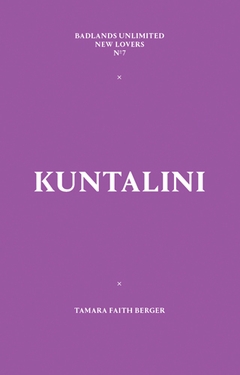 | Eat ass, pray, love. Twenty-five year-old Yoo-hoo experiences a sexual awakening in her yoga class. She breaks up with her boyfriend and travels to Niagara Falls where she meets a cold fish teen prostitute and an ex-Army troglodyte deep in the falls. Yoo-hoo’s unforgettable yogic journey sweeps across the realms of asana, hysteria, enlightenment. Kuntalini by Tamara Faith Berger is one of the New Lovers, a series of short erotic fiction published by Badlands Unlimited. Inspired by Maurice Girodias’ legendary Olympia Press, New Lovers features the raw and uncut writings of authors new to the erotic romance genre. Each story has its own unique take on relationships, intimacy, and sex, as well as the complexities that bedevil contemporary life and culture today. |
 RSS Feed
Rusty Talk
Rusty Talk Editor:
Adèle Barclay
The Rusty Toque interviews published writers, filmmakers, editors, publishers on writing, inspiration, craft, drafting, revision, editing, publishing, and community.
Unless otherwise stated all interviews are conducted by email.
Our goal is to introduce our readers to new voices and to share the insights of published/ produced writers which we hope will encourage and inspire those new to writing.
Archives
November 2017
February 2017
October 2016
September 2016
August 2016
June 2016
May 2016
April 2016
February 2016
January 2016
December 2015
October 2015
August 2015
July 2015
June 2015
March 2015
January 2015
December 2014
September 2014
August 2014
July 2014
May 2014
March 2014
December 2013
November 2013
October 2013
September 2013
May 2013
March 2013
February 2013
December 2012
November 2012
October 2012
September 2012
August 2012
July 2012
June 2012
May 2012
April 2012
March 2012
February 2012
January 2012
December 2011
November 2011
October 2011
September 2011
August 2011
Categories
All
Activist
Adele Barclay
Alex Carey
Alex Leslie
Amelia Gray
Andrew F. Sullivan
Ania Szado
Artist
Author
Bill Bissett
Bob Kerr
Bonnie Bowman
Brian Joseph Davis
Carolyn Smart
Cartoonists
Catherine Graham
Children
Christian Bok
Comedians
Cornelia Hoogland
Daniel Zomparelli
Danis Goulet
David Groulx
David Hickey
David Whitton
Dina Del Bucchia
Directors
Documentary
Editors
Elisabeth Harvor
Elizabeth Bachinsky
Emily Schultz
Erin Moure
Experimental
Fiction Writers
Filmmakers
Francisca Duran
Gary Barwin
Glenn Patterson
Griffin
Griffin Poetry Prize
Heather Birrell
Hoa Nguyen
Iain Macleod
Illustrators
Interview
Ivan E. Coyote
Jacob Mcarthur Mooney
Jacob Wren
Jacqueline Valencia
Jane Munro
Jeffrey St. Jules
Jennifer L. Knox
Julie Bruck
Karen Schindler
Kevin Chong
Laura Clarke
Laurie Gough
Linda Svendsen
Lisa Robertson
Lynne Tillman
Madeleine Thien
Maria Meindl
Marita Dachsel
Matt Lennox
Matt Rader
Media Artists
Michael Longley
Michael Robbins
Michael Turner
Michael Vass
Michael V. Smith
Mike Watt
Mina Shum
Mira Gonzalez
M. NourbeSe Philip
Monty Reid
Musician
Myra Bloom
Nadia Litz
Nonfiction Writers
Novelists
Patrick Friesen
Paul Dutton
Penn Kemp
Per Brask
Performers
Playwright
Poetry
Poets
Priscila Uppal
Producers
Publishers
Rachel Zolf
Ray Hsu
Renuka Jeyapalan
Richard Fulco
Richard Melo
Rick Moody
Robin Richardson
Rob Sheridan
Roddy Doyle
Russell Thornton
Sachiko Murakami
Salgood Sam
Scott Beckett
Screenwriters
Semi Chellas
Sharon Mccartney
Sheila Heti
Short Fiction Writers
Sound Artist
Steve Roden
Tanis Rideout
Tom Cull
Translation
Translators
Travel Writers
Trevor Abes
Tv Writers
Ulrikka S. Gernes
Vanessa Place
Visual Art
Vivieno Caldinelli
Writers
Zachariah Wells
