RUSTY TALK WITH MATT RADER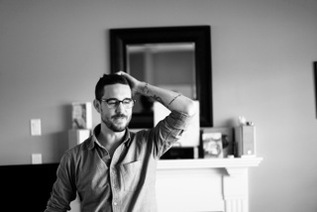 Matt Rader Matt RaderPhoto by Ron Pogue Matt Rader is the author of three collections of poetry, Miraculous Hours, Living Things, and most recently, A Doctor Pedalled Her Bicycle Over the River Arno. His poems have recently appeared in publications in the United States, Romania, the Czech Republic and Canada. He lives on Vancouver Island. Kerrie McNair: How did you first get into writing? Matt Rader: That’s one of those questions of history I’m always tempted to rewrite. I probably have several times. I recall writing in school as a kid. And I recall writing poems with my mum when I was eight or nine. Then I wrote poems all through high school. I took writing classes at the University of Victoria from age 18-21. But I didn’t start seriously until the fall after I graduated from my undergrad. That fall I wrote a poem called “Exodus.” Later that poem became the first poem I published professionally in sub-Terrain magazine. KM: What poets or writers did you read you when you first started out? Who are you reading now? MR: In those earlier years after my time at UVic, I read Ted Hughes exhaustively. Then I read Seamus Heaney who remains a major influence. Michael Longley was my primary influence for more than half a decade. In the last few years Larry Levis has been hugely important, and most recently I have fallen in love with Mary Ruefle’s poems. Heaney, Longley, Levis, and Ruefle are all currently represented in the Jenga of books on my bedside table. I could also tell this story with Homer, Keats, Hardy, Yeats and Eliot. Or Bishop, Plath, Lowell, Gilbert, and Larkin. Not to mention Babstock, Solie, O’Meara, Thornton, and Bachinsky. The problem with any list like this is that I can’t help but make egregious and unforgivable omissions. KM: You used to run a literary micro-press out of Vancouver for writers who were marginalized for a variety of reasons including age, content matter, sexuality and ethnicity. Can you describe how you got into literary/cultural activism and how it informs your writing? Are you working on any community projects at the moment? MR: I was lucky enough to meet a set of young artists and writers, largely centred in Vancouver in the early aughts, who had a desire to share their work with each other. Many of us had grown up in the DIY music and zine culture. Several of us were involved in various queer communities. We were culture makers and pursued that right into our publishing deals and writers festival invitations. I’ve been involved in several projects lately and there are few more in the works. A year ago I collaborated with my friend Grant Shilling to put on a community storytelling event. We live in a small mountain village on Vancouver Island. The foothills here have been ravaged over the last century and a quarter, first by coal mining and then later by logging. Currently the hills around our village are used both industrially for logging and recreationally as a major mountain biking destination. The event was called Bronco’s Perseverance: Changing Gears in Cumberland. Bronco’s Perseverance is the name of one of the main trails along Perseverance Creek. The trail is named after the long time Cumberland mayor, Bronco Moncrief. Our tagline was “Beer and bullshit.” It was amazing. This past summer I collaborated with a local designer, Sarah Kerr, to create large poster-sized newspapers modeled on papers from the 1913 that we researched in the Cumberland Archives. There were six pages and they told the story of two young girls during the height of the Great Vancouver Island Coal Strike that was 100 years ago this summer. We put the posters up around town. I wouldn’t say that my cultural activism informs my writing exactly, but I do think my writing is informed by the same impulses as my cultural activism. I can be didactic about it and try to make a case for aesthetic and moral value, for form and identity, for art as experience, but in the end, those impulses are as known and as mysterious to me as to anyone else. KM: You’ve been involved in curating several reading series such as the Robson Reading Series. Do you have any advice for new poets or writers on reading their work for an audience? MR: Read as slowly as you possibly can, then read a little bit slower. Always read less. I believe Mark Twain has a set of rules. Google Mark Twain’s rules. KM: Can you describe the writing process for your most recent collections of poems, A Doctor Pedaled Her Bicycle over the River Arno, which your publisher describes as unraveling “our layered identities to explore the lyrical fabric of humanity”? Over what length of time were the poems written? Was there a particular catalyst for this project? MR: The earliest poems in A Doctor were composed alongside the bulk of my previous collection Living Things and I was in the midst of composing the core poems in A Doctor when Living Things came out. All told, it probably took about three years to write. I was pursuing several things in that book. One was a reintegration of narrative into the poems, something that I felt I’d written out of my poetry in Living Things. Secondly, I was exploring cultural history in a way that I had explored ecocultures in Living Things. I was particularly looking at my family history on one hand, and the colonial and post-colonial history of coastal British Columbia on the other hand. It wasn’t really an either/or. These histories were more braided than that description suggests. Thirdly, I had been thinking since Living Things about poetic form and tradition and in A Doctor that became expressed as custom and customs. I was intrigued by the idea that custom and customs (or costumes as Elizabeth Bishop would have it!) can be both the guarantor of civilization and a purveyor of horrific violence. KM: Many of the poems such as “I Acknowledge: and “History” in A Doctor Pedalled Her Bicycle over the River Arno detail the lasting presence of history in contemporary life. How did the past motivate your desire to define the present when it came to writing these poems? MR: John Dewey says “art celebrates with peculiar intensity the moments in which the past reënforces the present and in which the future is a quickening of what now is.” I really like how he says, “what now is” instead of “what is now.” I know that I should be more generous and explain what I think this means, but I don’t want to. I tend to see everything relationally, which is to say with a kind of historicity. KM: Conversely, poems like “Natural Lives” and “Homeowners Manual” address sentiments of devotion. Was it a conscious decision to, at some point, stop looking back? MR: No. I never did stop looking back. Though I don’t think of the past as being “back there.” Looking at history is looking in the mirror. Looking in the mirror is looking at history. KM: What is your funniest or favourite literary moment, if you have one? MR: When I was a small boy Dennis Lee came to my small island town and gave a reading for children. I remember the bookstore as having creaky old wooden planks for a floor. Everything seemed very dark. He picked me out of the crowd and sat me on his knee and began to recite a poem. To which I promptly ran away crying. Then, nearly thirty years later, after the launch of my last book in Toronto, I walked out the party and standing in the street at the bottom of the stairs was Dennis Lee. He was holding my book! I introduced myself and we said kind things to each other and then I told him the story I’ve just related here and he said … well, I can’t tell you what he said, not in print. But if I’m ever in your town you can buy me a beer and I’ll tell you the rest … KM: What are you working on now? MR: I have a collection of short stories that’s meant to come out next fall. I’m also working on a new book of poems with a kind of deep hermetic code. They’re largely elegiac. I’m also about to embark on a filmmaking project with a young filmmaker, called Jim Vanderhorst. I have a chapbook of poems coming out with Baseline Press at some point in 2014. Enjoy an excerpt from Matt Rader's forthcoming chapbook from Baseline Press: UNSPEAKABLE ACTS IN CARS It’s the first day of summer and we’re so happy To see the sun and the satchel of colours it schleps All those dark kilometres. The sky is so blue And the sea is blue and the small islands in the sea Are blue also. How our sun must love blue. We have beachgrass and bull kelp and lion’s mane And we love them all because we love the sea Which is cold and buoyant. Friends now of seasalt And knotweed, the mountains know all about us And who we are when we are most ourselves. But their blue haughty distances are no help. We are who we are with mock orange and wisteria. We’ve nothing to bitch about. The high cirrus Can’t touch us. We been alive just long enough. originally published in The Fiddlehead 253 DOVE CREEK HALL (FORMERLY SWEDES' HALL) The children play their fiddles so slowly I am sad For the old wooden hall among the cow patties. Who cut the rhodo blooms and set them on the piano? They bow tiredly through every tune. Even the cows Have wandered away from the music to the far side Of the pasture. All the Swedes who built this hall Are dead now and the women they married are dead And the pastor who married them and their friends. But the children do not know this or just how sad Beauty is on the last day of spring with instruments And young players making music beneath the rafters. They play along with mistakes and embarrassment. Tell me, who hung the hand-stitched stars on the wall? Who hung the evening light from the windows? originally published in Arc 67 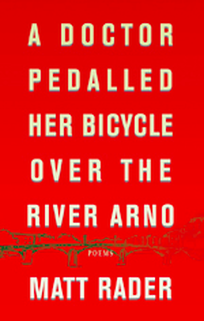 MATT RADER'S MOST RECENT BOOK OF POETRY
A Doctor Pedalled Her Bicycle Over the River Arno House of Anansi Press, 2011 Description from publisher: A Doctor Pedalled Her Bicycle Over the River Arno carries within it all the technique, vision, imaginative labour, and razor-sharp precision of Matt Rader’s first two collections, Living Things and Miraculous Hours. But it also ascends to a new and luminous, demanding, particularized realm of the human. Wildflowers and weeds, newspaper archives and illness, hostels and hostiles, parenting and the shadowy history of grandparents, war and Renaissance paintings: Matt Rader’s unassuming, deeply spirited, and expansive poems show us again how contemporary lyric can go such a long way toward revealing our true homes to us at the moment we find ourselves most nakedly un-housed. Rader seeks out limits, borders, and frontiers—those mapped for us by authority, and the concomitant, interior shadowlines we ourselves draw—in order to test their validity. 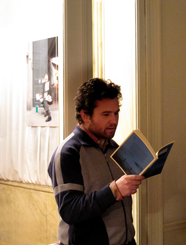 Jacob Wren Jacob WrenPhoto by Brancolia JACOB WREN is a writer and maker of eccentric performances. His books include: Unrehearsed Beauty, Families Are Formed Through Copulation and Revenge Fantasies of the Politically Dispossessed. As co-artistic director of Montreal-based interdisciplinary group PME-ART he has co-created the performances: En français comme en anglais, it's easy to criticize (1998), the HOSPITALITÉ / HOSPITALITY series including Individualism Was A Mistake (2008) and The DJ Who Gave Too Much Information (2011) and Every Song I’ve Ever Written (2012). He travels internationally with alarming frequency and frequently writes about contemporary art. RUSTY TALK WITH JACOB WREN Kathryn Mockler: What is your first memory of writing creatively or being creative? Jacob Wren: I don’t know if I have a first memory. But I do know around age thirteen I started suffering from terrible insomnia. Some nights I didn’t sleep at all, while most nights I slept very little. And basically I just filled the endless, sleepless nights with reading and writing, for more or less ten years, until I realized that the simple cure for my insomnia was rigorous physical exercise. Still, to this day, I associate writing with the strange, hallucinatory state that comes from having barely slept for weeks on end, as a kind of unreal trance, almost like a dream. It was during those nights, lying awake, almost too tired to move, that I first trained myself to write. KM: Why did you become an artist/writer and what keeps you going? JW: To be honest, the only thing that has ever really interested me was art (in all its many forms.) I wish I could become interested in something else, since I feel, as a human being, at times this overemphasis on artistic interests makes me a bit narrow, as well as making my interactions with other people often rather difficult. (I mean, I do my best.) At the same time, I find it very hard to maintain any interest in art and often don’t know exactly what keeps me going (except that I have no idea what else I could possibly do). Sometimes I remind myself a bit of this apocryphal story of a Russian who moved to New York but never learned English. Gradually, over the course of his life, he forgot how to speak Russian, yet still never learned English, so in the end he spoke no language at all. Gradually I am becoming less and less interested in art, while not really becoming interested in anything else, so in the end I’m kind of nowhere. Like a priest who has lost faith. But that makes it all sound more dire than it actually is. Still, I think it’s important that we talk about these things, since hardly anyone ever does. I have often said that I don’t particularly relate to people who make performance, or write, or make art, but I do relate to people who make performance / writing / art who think about quitting every fifteen seconds. Those are really my people. I call us the ‘boy who cried wolf set’. Because, for me, if you really look at art today, at what it means, at who it reaches, at what is considered successful or important, it often seems like a complete waste of time. If I had any talent for it, or drive towards it, I would definitely quit art and become an activist, since the world’s problems are now so overwhelming, immediate and tragic. But, for better or worse, I can’t seem to get myself to do anything else: all I can really do is write. (Well, I also make performances, but that becomes harder and harder as the years roll on.) KM: How would you describe your writing process? How does your blog A Radical Cut in the Texture of Reality fit into this process? JW: I mainly feel like I don’t really have a process. I just have ideas and write them down to the best of my ability. Often I try to write every morning, but then, at other times, I am stuck for months on end and write very little. I usually do a first draft in a notebook, and then type it up as I go. Sometimes there is a little bit of re-writing as I type it into the computer, but mainly the second draft just allows me to think more about what I’m doing. I definitely started my blog, in 2005, because I had almost completely stopped writing and was looking for a way to start again. It’s always been difficult for me to get published—I suppose what I write doesn’t quite fit anywhere (maybe it’s a little bit easier now, I’m not sure)—but at the time being able to just post what I was writing on my blog, as I went along, gave me more of a feeling that I was actually doing something. I would tell myself: just write one paragraph and post it, then at least you will have written one paragraph. It kind of made me feel like writing was possible again, after having felt it was basically impossible for many years. (Mainly due to too many rejection letters, or more precisely to the fact that I’m a little bit too sensitive to such things.) Now my blog gets about 2,000 hits a month, so that must mean someone is reading it, but I don’t really have any sense of who is reading it, why, or what they think. There are hardly any comments. I spend so much time on the internet (mainly on Facebook and listening to music), and I know this has deeply affected how I think about art, about writing, and also how I practice it. It is difficult for me to really analyze what this change might be, it has all been so natural and intuitive, but I know there is something about the shuffle feature on iTunes, and about the seeming randomness as one clicks from one link to the next, that has been completely folded into my aesthetic. KM: What or who influences your writing? JW: I keep an ongoing list of favourite books: Some Favourite Books And recently I have added a list of visual artists: List of Artists But mainly I just want to devour everything. I want to have an overview. I want to know what is happening in art today, and everything that has ever happened in art before, and I want to use all of it while at the same time making it my own. I want to speak about the world, about the world today and about history, about ideas, thinking, philosophy, theory, and about my own subjective experiences. I want to struggle with it, admit to failure, be upset that I am not as good as the artists and authors I love but keep trying. I wish the mainstream was more open and more interesting. KM: Can you discuss the relationship between writer and reader or audience? Who would be your ideal reader? I’m interested also in terms of your blog and its readership. Does that audience inform your work in any way? JW: I have a sort of double life, half writing, the other half performing. When you perform the audience is right there in front of you, and all of my performance work is about trying to honestly deal with the fact that the audience is right there in front of me, about the paradox of trying to be yourself in the deeply unnatural situation of a room full of strangers watching you. I’ve always like the Gertrude Stein quote: “I write for myself and strangers.” When I was revising my last book, I showed it to a bunch of friends for comments, and I listened to all of their comments, and later, when the book came out, realized I had completely ignored basically all of their suggestions. I had asked for their help, and then completely ignored everything they said. (Well, I’ve always been stubborn.) And I feel this is so often the way between me and readers, I listen to every comment I get, think about it, try to take it in, fully absorb it, but never directly respond to anything anyone says. Nonetheless, I very much hope it is all in there anyway, somewhere in my head, affecting what I think, how I see what I’m doing, in some completely indirect way making the work better. KM: What is the best piece of literary advice you’ve gotten that you actually use? JW: As I’ve already suggested, I’m so bad with taking advice. But I really liked reading what Alain Badiou once said in an interview. He said the only rule for activism is: keep going. And I guess that’s mainly what I try to do now, keep going, which also means not making too many compromises, trying to offer up something different enough from everything else out there, trying to see the world a different way and put it into words. But, then again, I also constantly want to quit. Which is maybe why the advice is so important. Keep going. KM: What is your favourite or funniest literary moment, if you have one? JW: I actually can’t think of anything at the moment. Hopefully that means there are many favourite, hilarious literary moments to come. Maybe the future will be full of them. KM: What are you reading at the moment? JW: I just started reading The Empire Within: Postcolonial Thought and Political Activism in Sixties Montreal by Sean Mills. I believe I must be reading it because I live in Montreal. So far it’s fascinating. KM: What projects are you working on in 2013? JW: I am writing a new book entitled Polyamorous Love Song. Here is a short synopsis: It is a book of many different narrative through-lines. For example: 1) A mysterious group, known as The Mascot Front, who wear furry mascot costumes at all times and are fighting a revolutionary war for their right to wear furry mascot costumes at all times. 2) A movement known as the ‘New Filmmaking’ in which, instead of shooting and editing a film, one simply does all of the things that would have been in the film, but in real life. This movement has many adherents. Its founder is known only as Filmmaker A. 3) A group of ‘New Filmmakers’, calling themselves The Centre for Productive Compromise, who devise increasingly strange sexual scenarios with complete strangers. They invent a drug that allows them to intuit the cell phone number of anyone they see, allowing phone calls to be the first stage of their spontaneous, yet somehow carefully scripted, seductions. 4) A secret society that concocts a sexually transmitted virus that infects only those on the political right. They stage large-scale orgies, creating unexpected intimacies and connections between individuals who are otherwise savagely opposed to one another. 5) A radical leftist who catches this virus, forcing her to question the depth of her considerable leftist credentials. 6) A German barber in New York who, out of scorn for the stupidity of his American clients, gives them avant-garde haircuts, unintentionally achieving acclaim among the bohemian set who consider his haircuts to be strange works of art. And yet each of these stories is only the beginning. And we are also beginning a new, ongoing internet/performance project entitled Every Song I’ve Ever Written. Here is a description: From 1985 to 2004 Jacob Wren wrote songs. Lots and lots of songs. At the time not very many people heard them. Every Song I’ve Ever Written is a project about memory, history, things that may or may not exist, songwriting, the internet and pop culture. On the website everysongiveeverwritten.com you can listen to, and download, these songs. In a way, because hardly anyone heard them, these songs don’t yet exist. If you are reading this, we would like you to consider recording your own version of one of these songs, changing it, making it your own, then sending it to us. We will post every version we receive. There will also be performances and events. Solo performances will feature Jacob performing all of the songs in chronological order (it takes about five hours.) Band Nights will feature a series of local bands in different cities performing one of Jacob’s songs each. After each version, Jacob will interview the band about what it was like to cover the song, and the band will interview Jacob about what it was like to write it. We are not doing this because we think these are the best songs ever (we hope at least a few of them are good.) We are doing this because hardly anyone heard them at the time, and we are wondering if there is some new, strange way to bring them out into the world. In doing so we hope to raise a few questions about what songs mean on the internet, about what songwriting is actually like today, and also take a sidelong glance back at the recent past. LINKS Radical Cut in the Texture of Reality Every Song I've Ever Written PME-ART Tumblr Goodreads Le Quartanier 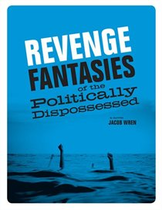 REVENGE FANTASIES OF THE POLITICALLY DISPOSSESSED
Pedlar Press, 2010 Description from Pedlar Press: Set in a dystopian near-future, Revenge Fantasies of the Politically Dispossessed is a novel - a kind of post-capitalist soap opera - about a group of people who regularly attend ''the meetings.'' At the meetings they have agreed to talk, and only talk, about how to re-ignite the left, for fear if they were to do more, if they were to actually engage in real acts of resistance or activism, they would be arrested, imprisoned, or worse. Revenge Fantasies is a book about community. It is also a book about fear. Characters leave the meetings and we follow them out into their lives. The characters we see most frequently are the Doctor, the Writer and the Third Wheel. As the book progresses we see these characters, and others, disengage and re-engage with questions the meetings have brought into their lives. The Doctor ends up running a reality television show about political activism. The Third Wheel ends up in an unnamed Latin American country, trying to make things better but possibly making them worse. The Writer ends up in jail for writing a book that suggests it is politically emancipatory for teachers to sleep with their students. And throughout all of this the meetings continue: aimless, thoughtful, disturbing, trying to keep a feeling of hope and potential alive in what begin to look like increasingly dark times. Revenge Fantasies asks us to think about why so many of us today, even those with a genuine interest in political questions, feel so deeply powerless to change and affect the world that surrounds us, suggesting that, even within such feelings of relative powerlessness, there can still be energizing surges of emancipation and action RUSTY TALK WITH PENN KEMP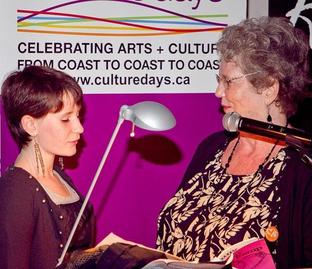 Penn Kemp Penn KempPhoto by Wendy Saby London, Ontario performance poet, activist and playwright Penn Kemp is the 40th Life Member of the League of Canadian Poets. This year she received the Queen Elizabeth 11 Diamond Jubilee medal for service to the arts. Penn has published twenty-five books of poetry and drama, had six plays and ten CDs produced as well as Canada’s first poetry CD-ROM and several award-winning videopoems. As the inaugural Poet Laureate for the City of London, she initiated and judged Poetry in Motion and the National Haiku Competition. As Canada Council Writer-in-Residence for University of Western Ontario for 2009-10, her project was the DVD, Luminous Entrance: a Sound Opera for Climate Change, Pendas Productions. Kathryn Mockler: What is your first memory of writing creatively? Penn Kemp: I remember my own early discovery of and delight in language. As a child, I did not coddle my dolls. I sat them up and read the poems, stories and nursery rhymes my mother had read to me. The words she read would sink into the well of my hearing and become part of me; their rhythms would dance inside my body like northern lights. I ate up those words with a necessity as strong as hunger. Even at first hearing, the words were somehow familiar as if I recognized in them old friends. I remember swelling proudly with the power of words, in learning first to read and then actually to write, to put down the letters so that they made sense to anyone who could read. I wrote my first poem when I was six, excited and amazed at having created through apparent magic something out of nothing with marks on a page accompanied by a drawing of kids skating. I glimpsed a world in which words had a life of their own, just as toys did. I knew that if I could wake at the right time at night I would catch my toys at play. So too, I felt words could be surprised and brought to life on the page. Writing that first poem was the first time that I recall consciously feeling that I was doing an adult thing creating something entirely on my own, assuming independence growing up! I felt like the Little Red Hen in the nursery story: "‘I can do it myself,’ said The Little Red Hen, and she did." KM: What keeps you going as a poet or why do you write? PK: When I write, I begin an adventure equipped with my writing tools and everything else I know about myself and the world. By the end of the day, everything I knew and thought may be transformed or discarded. It intrigues me that what I know and start off with is the very means for realizing what is unknown. I write to articulate the moment, to puzzle out feelings or incidents I can't figure out. The best poems come, though, when I follow the language of a striking phrase. Sound leads me. KM: Could you describe your writing process? (For example, do you write every day? When? Where? How do you approach revision, etc.) PK: I write every day, in the morning, in the little room that was my childhood bedroom. It looks out on a small greenhouse, a source of inspiration and delight all year. The green throughout the winter keeps me from getting restless and hungry for sun. Often in the morning as I transcribe dreams, they become poems. They're not usually very good poems so they don't see the light of day beyond a file in my computer, but they keep the energy of poetry flowing. The problem I have with them is that they are too narrative and I feel I need to stick to the literal story line that the dream gave me. I revise constantly, even when I am performing, pencil often in hand. Reading the poem in front of an audience allows me to really hear what works...and what does not. My first book, Bearing Down, was performed in four voices for a Seattle FM radio show in 1973. That performance opened up the door to possibilities for the spoken word in those early days. I've been lifting the word off the page any way I could since then, most recently in videopoems. But the ear remains my first love. Concentrating on the voice rather than gesture or physical presence in communicating poetry has taught me to listen acutely, and that's had an effect not just on my sound poetry but on all my work. Collaborating with artists of different disciplines is exciting and energizing. And with the Cloud, friends and fans can hear the work in Brazil, in India, in Britain simultaneously!” KM; What writers were influential to you when you first started out? And what poets are you reading now? PK: Victor Coleman, the editor at Coach House Press and a neighbour on Toronto Island, was influential and encouraging in introducing me to the poetic community across North America. My first book, Bearing Down, came out from Coach House, 1972. I organized a poetry reading series at A SPACE in Toronto for several years in the early Seventies. I invited poets I admired, like P. K. Page, Phyllis Webb, Daphne Marlatt, all of whom became friends and correspondents. In those days, the Canada Council sponsored American poets so I invited heroes like Diane di Prima, Allan Ginsberg, Robert Creeley and Edward Dorn, all very influential. I read avidly and widely as poetry continues to inspire new poems. These days I edit quite a few manuscripts for poets, and I read poets coming to London as well as books for my literary radio show, Gathering Voices. And new books coming out: I particularly like Brick Books. KM: Your funniest literary moment, if you have one. PK: The funniest literary moment happened this year on January 11 at 8.30am. As Poet Laureate for the City of London, I was formally addressing 1200 folks at the Mayor's STATE OF THE CITY ADDRESS” at the London Convention Centre. The topic was “Believe…”. Well, I couldn't believe the three very audible interruptions! They turned out to be the complaints of a Russian robot. It was squawking in Russian that its battery was wound down. I kept on talking: you can see the situation on livestream. KM: What are you working on now? PK: I wish I could say that I'm finishing a manuscript and I am, slowly, but the times demand I continue as an activist in protesting federal budget cuts. So I'm organizing a reading Saturday, September 29, 2012, 2-4 pm. "100,000 Poets for Change" Reading for Culture Day. Landon Public Library (downstairs), 167 Wortley Rd., London, ON. Our free afternoon reading will be part of an international event which will take place in many cities, in many villages and in the countryside all over the world, at the same time and date. The first order of change is for poets to get together to perform, educate and entertain, simultaneously with others around the world, changing how we see our own community and the global community. The host in Toronto who asked me to organize a London reading may be doing some Skype connections with us and other cities, other provinces. Such an event ties in nicely with our national Culture Days happening at the same time. There will be a blog for us on 100,000 Poets for Change. Twenty-three poets are signed up, including Susan McMaster, President of The League of Canadian Poets. Musicians Jennifer White and Robert McMaster as well! Good will? Immeasurable! And I am writing a book on Jack Layton's support of and interest in the arts in Canada. I'm now collecting anecdotes, reminiscences and opinions or observations about Jack and the arts Jack in the arts (that guitar, that piano, that revised song!) the role of the arts for him. As Jack would remind me, he was a proud member of the Writers’ Union! I've just collated all his emails to us and they include some interesting discussions. They're bitter-sweetly sad to read now, given all we have lost in Jack...but of course we continue in hope. I’ll also be interviewing folks for my radio show, Gathering Voices. Olivia Chow endorses the work: "I heartily encourage folks to send Penn your stories of Jack’s relationship with and his support of the arts. This project is a great opportunity to share our stories about how Jack and the NDP celebrated our Canadian cultures and what we must do together to continue this relationship. You know he loved to make music and we loved to dance!" When Jack Layton died last August, he was given a state funeral. Roy Thompson Hall was packed; the lineup of artists celebrating Jack stellar and the street theatre outside was sublime. I would like to commemorate Jack’s birthday in July and the first anniversary of his death with two e-shorts on Amazon.ca. I believe such pieces would be timely and widely read, given the nation’s outpouring of love and sympathy. Jack Layton's support of and interest in the arts in Canada underlay his politics. In his long municipal and federal political life, he always included and encouraged artists to become activists. My working title is Jack Layton: Art for Action! On Saturday, August 4, I'm participating in The Summer Soirée Festival of the Arts, Aeolian Performance Hall, London, Ontario. Afternoon workshop Gary Diggins, Jocelyn Drainie and me on The Healing Nature of Sound and then an evening performance, Sonica Hypnotica. Chris Meloche and I will kick off the evening event with new work in progress from The Electric Folklore Machine. 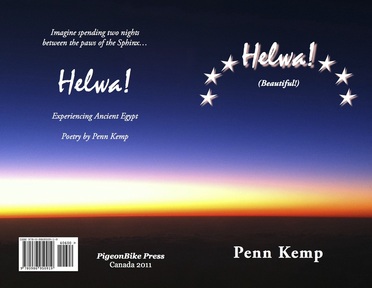 PENN KEMP'S MOST RECENT BOOK Helwa!, PigeonBike Press, 2011 Description PigeonBike Press has launched Penn Kemp's chapbook of Helwa! alongside the release by Pendas Production of Penn Kemp's CD, Night Vision, which includes Helwa!. Since her first book was published by Coach House Press in 1972, she has been pushing textual and aural boundaries, often in participatory performance work. Many of her recent CDs are what Penn terms "Sound Operas": poetic narratives that weave sound, imagery and music in the counterpoint of many voices. Working across a variety of cultural practices to engage her audience, she hosts an eclectic literary show, Gathering Voices, archived on CHRW. Having performed in festivals around the world, most recently in Britain, Brazil and India, Penn lives in London Canada, where she edits poetry for Pendas Productions, a small poetry publisher she and husband Gavin Stairs run. Penn has been heralded by the Writers’ Union as a “one woman literary industry”. BETWEEN BETWEEN Between Between is a short film that concerns the process of mourning, translating some of Penn Kemp's performance poetry into visual imagery for a compelling, evocative portrayal of that state. Between Between examines the experience both of the mourner and (perhaps) of the newly dead. A Penn Kemp and Dennis Siren collaboration.
Kathryn Mockler is the publisher of The Rusty Toque. 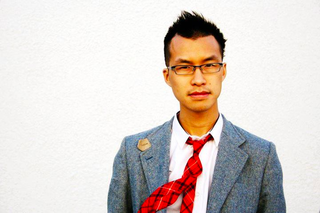 Ray Hsu Photo by Clare Yow Dr. Ray Hsu is co-founder of the Art Song Lab, an interdisciplinary platform that partners 24 writers and composers to create fusions in the genre of art song alongside performers. While completing his Ph.D. at the University of Wisconsin-Madison, he taught for two years in a US prison, where he founded the Prison Writing Workshop. The Workshop brings campus-based writers to the prison to write alongside incarcerated writers in a writers’ studio environment and mentors incarcerated writers writing towards their High-School Equivalency Diplomas. Dr. Hsu is the author of two award-winning books and writing in over fifty publications internationally. His work has been set to music and adapted for film. In addition to teaching and consulting, he has been interviewed for television, radio, and print media as UBC Expert in youth trends, popular culture, and diversity. RUSTY TALK WITH RAY HSU Kathryn Mockler: What is your first memory of being creative or writing creatively? Ray Hsu: In grade 2 we had to make a book. I wrapped corrugated cardboard in felt for the covers. For the plot I ripped off the storyline for Omega Race: KM: Why did you become a poet? RH: They seemed to be having so much more fun than novelists, or at least I thought so as an undergrad. KM: Could you describe your writing process? RH: I barely write at all. Or the poems write themselves, if by poems you mean taking screen capture videos of me playing Diablo 3 in which I play a barbarian named "Poem." KM: Do you have any advice on how to help new writers prepare to read or perform their work to an audience and/or to best engage an audience? RH: The best thing to do is to not look over everyone's heads. Folks who do that prolly heard once that they should make "eye contact," so instead they look over everyone's heads. It's even more distracting than burying one's face in the page. Once a friend kept looking over everyone's head while I was in the audience. My friends and students were trying to nudge me awake as subtly as they could. I call this piece, "The Critic." KM: What writers or poets would you recommended to an aspiring writers? Or what writers were influential to you when you first started out? RH: Anne Carson. Carleton Wilson. Al Moritz. Michael Ondaatje. Carleton Wilson. KM: Could you discuss your interest in activism, collaboration, and experimentation and how these have influenced your artistic practise? RH: A former member of the Weather Underground once said that the difference between being an activist and being an organizer is that organizing involves a whole lot of people whereas activism does not necessarily involve a lot of people. Collaboration, which involves at least one other person, is appealing because I bore myself. I like to organize with my audiences. Or call them participants. KM: Your funniest literary moment. RH: This: ...may be funny in a different way from this: KM: What are you working on now? RH: Laying siege to the idea of "Asian Canadian culture" through this here print magazine: 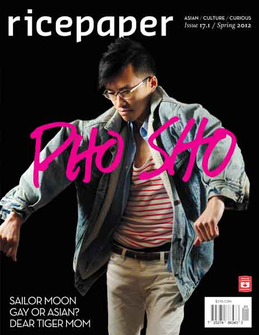 Ricepaper 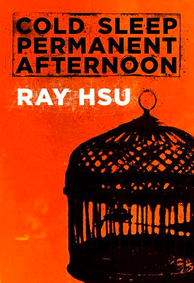 RAY HSU'S MOST RECENT BOOK
Cold Sleep Permanent Afternoon, Harbour Publishing, 2010 Description from the publisher Cold Sleep Permanent Afternoon, the follow-up to Ray Hsu’s award-winning first collection, Anthropy, is the second book in a prospective trilogy that explores the “grammar of personhood.” |
Rusty Talk
Rusty Talk Editor: Archives
November 2017
Categories
All
|

 RSS Feed
